
No spoilers here. Click through to see the answers.
If you haven’t seen the crossword puzzles, yet, check out the previous post on the Children’s Hospital of San Francisco Alumnae Association collection.
No spoilers here. Click through to see the answers.
If you haven’t seen the crossword puzzles, yet, check out the previous post on the Children’s Hospital of San Francisco Alumnae Association collection.
We’ve recently acquired a collection from the Children’s Hospital of San Francisco Nurses’ Alumnae Association, MSS 2006-17. Let’s break that down.

Children’s Hospital of San Francisco Training School for Nurses Little Jim yearbook, 1925, page 45, MSS 2006-17.
The California Pacific Medical Center’s historical timeline and UCSF History site prove quite useful for untangling this history. In 1875 the Pacific Dispensary for Women and Children was founded in San Francisco. It underwent a name change and became, more recognizably, the Women’s and Children’s Hospital. Under the leadership of the pioneering Dr. Charlotte Blake Brown (1846-1904) in 1882, the hospital began offering a two-year training program for nurses– the first official of its kind on the West Coast. And in 1887, it finds a new home at the intersection of California & Maple streets. At this point, “the two-story hospital has 25 private rooms, open wards, a cow barn, chicken yard, and laundry. Total cost, with furniture and equipment: $26,000.” The University of California Medical School (that’s us– UCSF!) begins partnering with Children’s Hospital in 1915 to teach medical students.
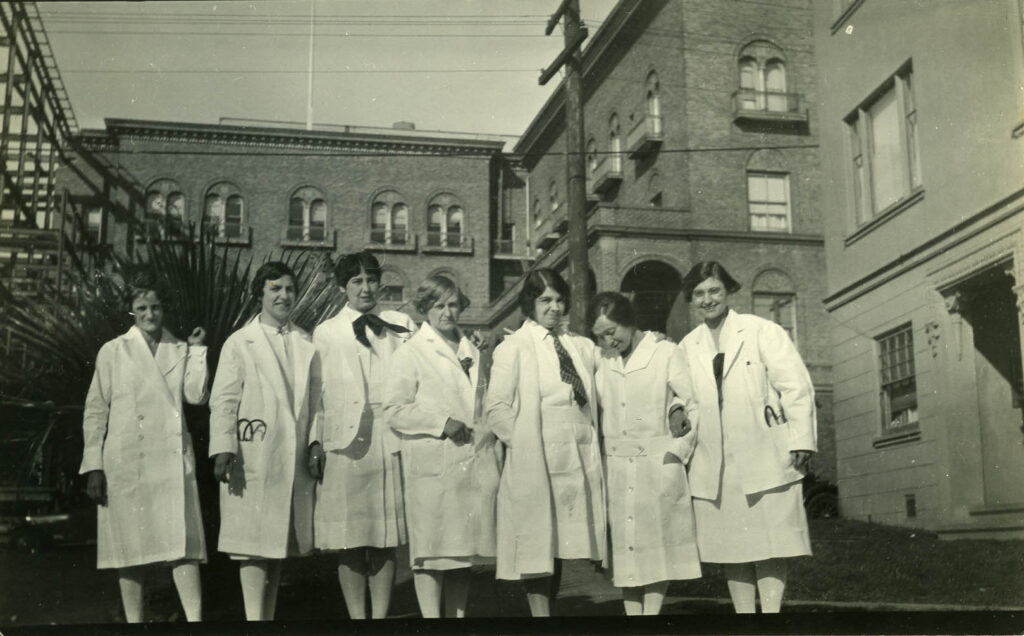
Group of nursing students, circa 1925, MSS 2006-17.
Which brings us just to about the time period of this collection. Donated by the granddaughter of Ruth Steuben, an alumna of the Children’s Hospital Training School for Nurses, the material covers the education of Steuben, roughly 1925-1929, and includes class notes, yearbooks, photographs, and a uniform apron. Digital copies of Steuben’s school records as well as photographs and letters from the mothers of children nursed by Steuben soon after her graduation are also included. Below, a photograph of Ruth with her graduating class, December 1927, from the Little Jim yearbook.
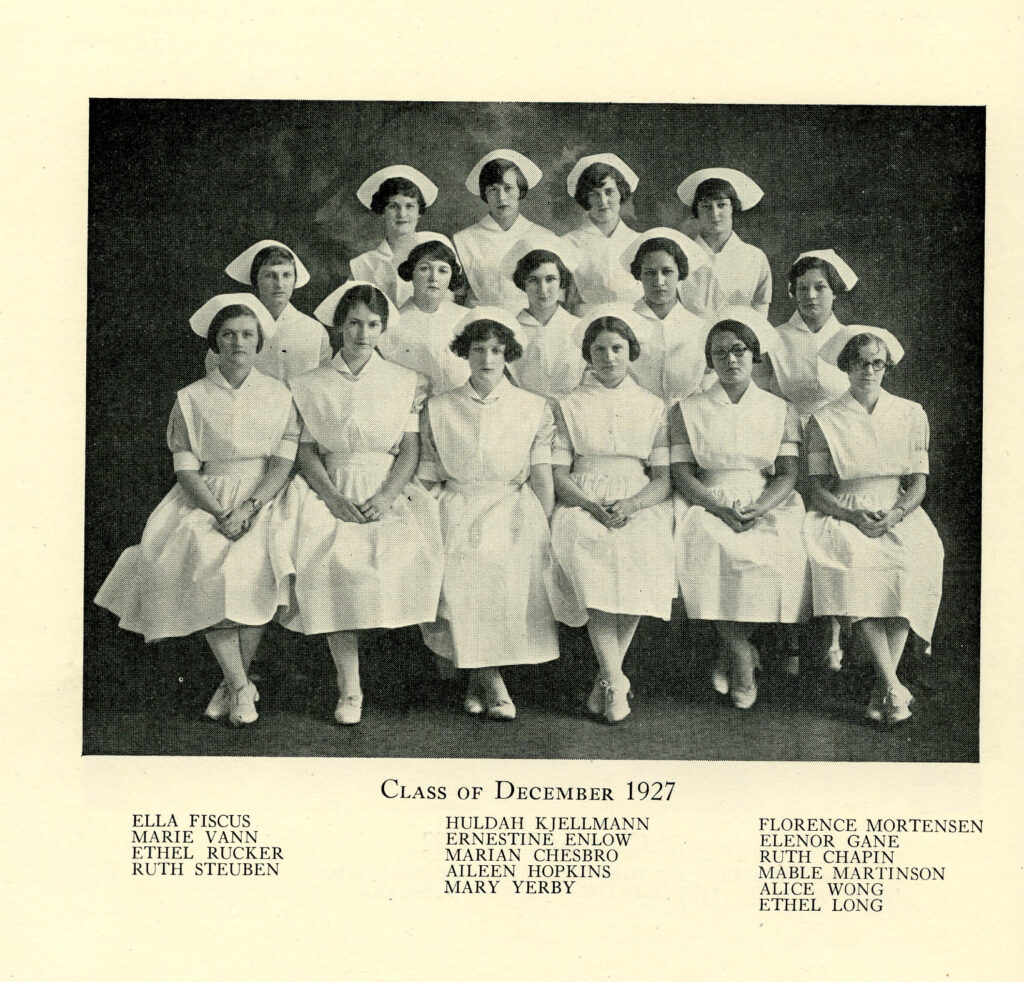
Class of December 1927, including Ruth Steuben. Children’s Hospital of San Francisco Training School for Nurses Little Jim yearbook, 1926, page 22, MSS 2006-17.
And a photograph of many of the same students at a nursing school reunion event in May 1948.
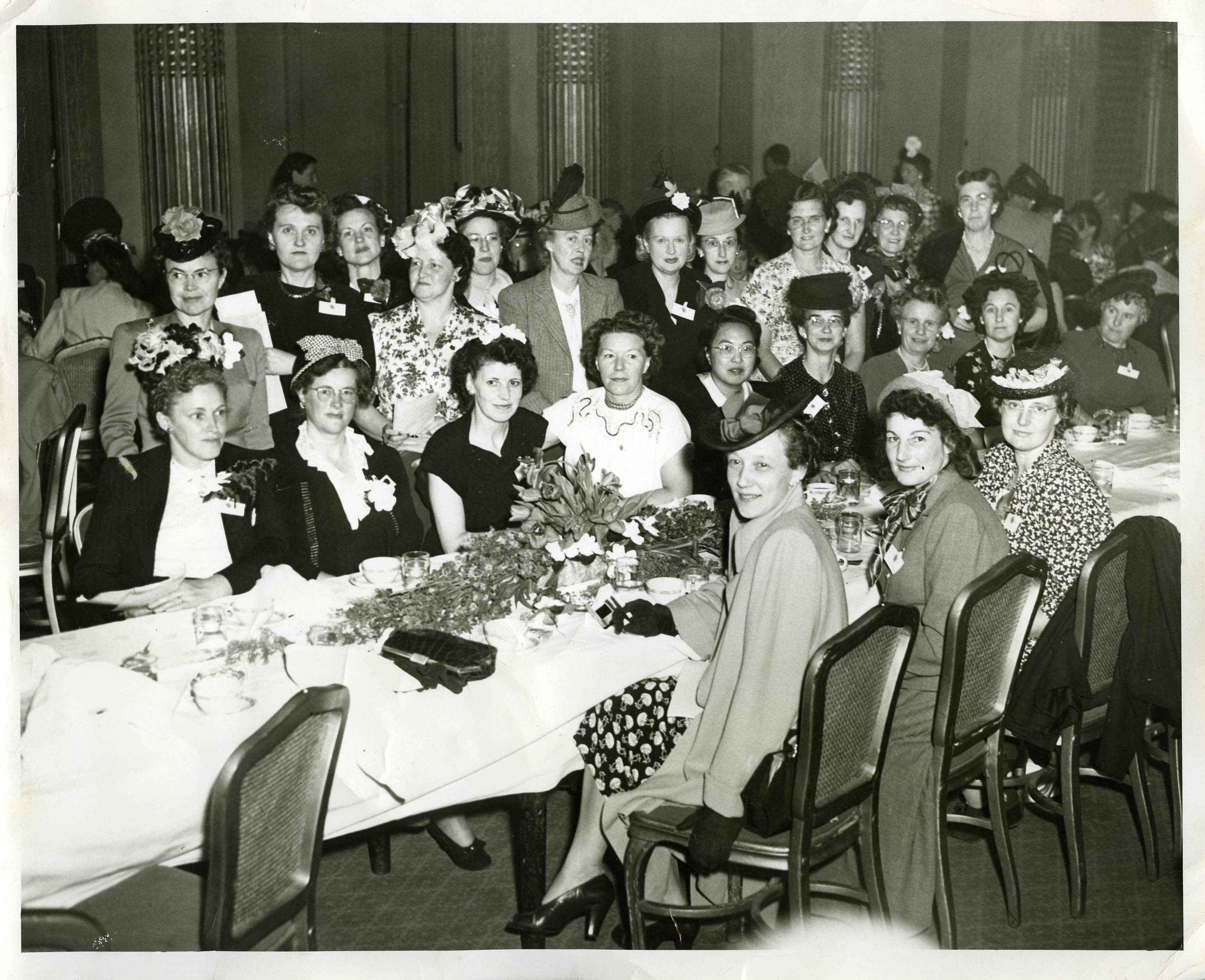
Reunion of nursing school graduates, May 1948, MSS 2006-17.
And now, for your further enjoyment: crossword puzzles! The 1948 Little Jim yearbook includes not one, but two crossword puzzles. The first was created by Adelaide Brown, M.D. (1868-1933) who was the daughter of Dr. Charlotte Blake Brown– both were longtime activists for women and children’s health.
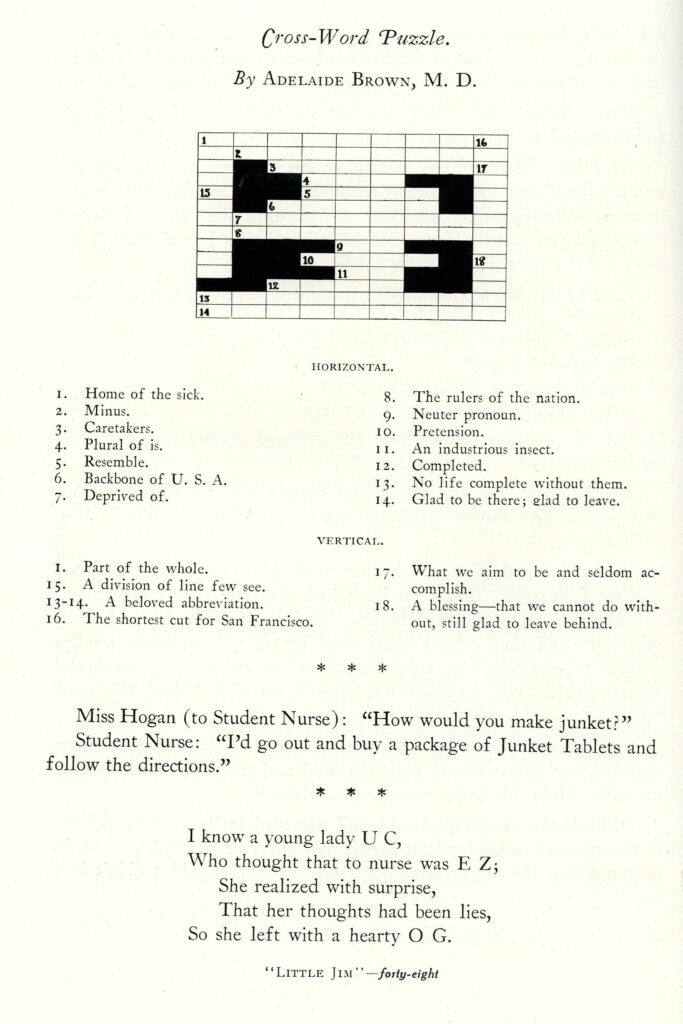
Crossword puzzle by Adelaide Brown, M.D. Children’s Hospital of San Francisco Training School for Nurses Little Jim yearbook, 1925, page 48, MSS 2006-17.
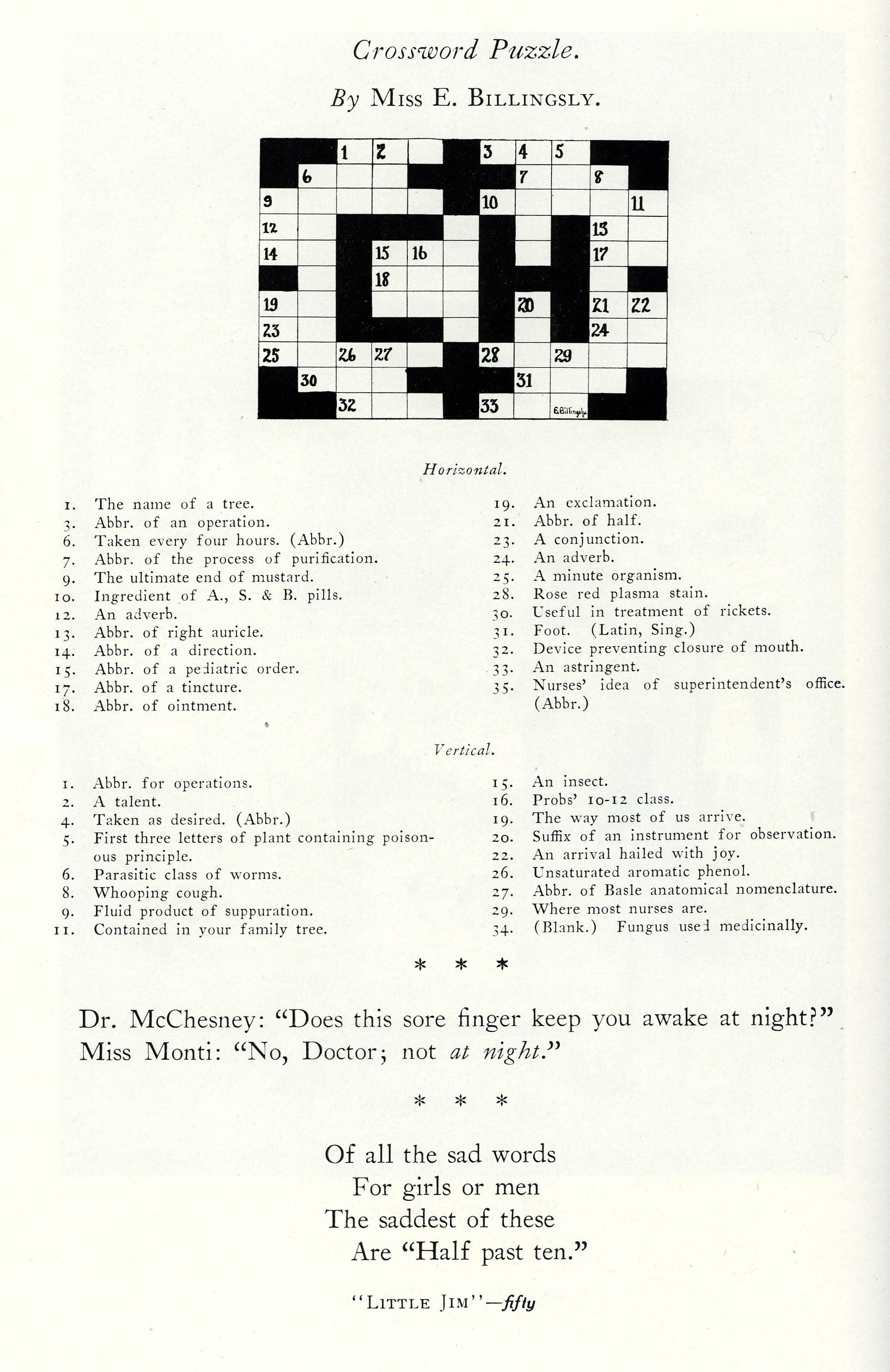
Crossword puzzle. Children’s Hospital of San Francisco Training School for Nurses Little Jim yearbook, 1925, page 50, MSS 2006-17.
Please see our other collections regarding the Children’s Hospital of San Francisco Nursing School Alumnae Association, MSS 89-20 and MSS 91-101. Read more about Dr. Charlotte Blake Brown in this fascinating article, The San Francisco Experiment: Female Medical Practitioners Caring for Women and Children, 1875-1932, by Meredith Eliassen and published online in Gender Forum.
In the spirit of UCSF’s 150th anniversary, a new addition to the archives has been made: the history of our very own Dr. Eddie Leong Way. The addition is very much relevant to the anniversary, as Dr. Way himself has contributed much to the school’s 150 years. In fact, he makes up many of those years, himself.
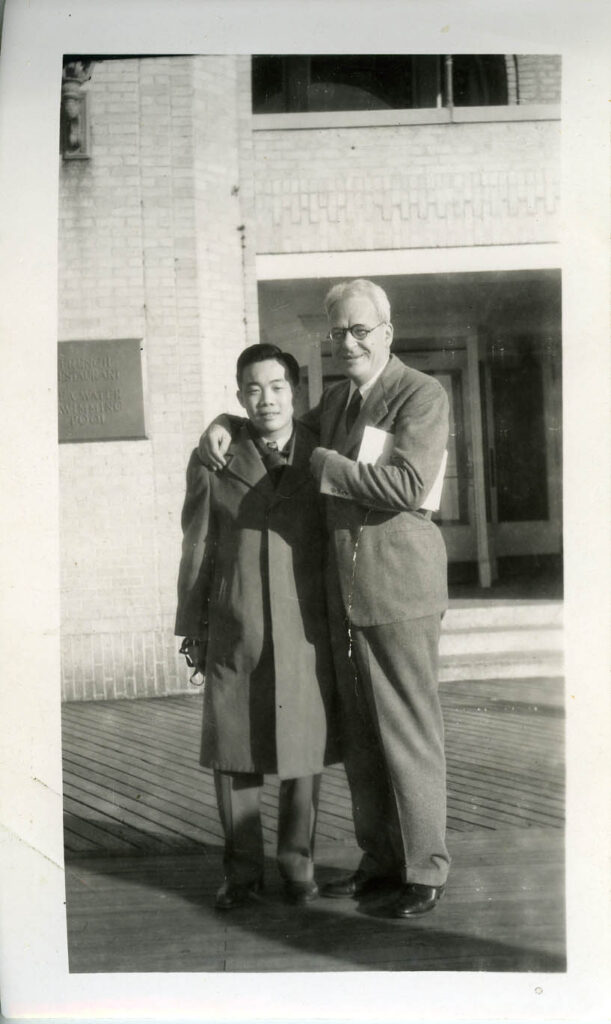
E. Leong Way and Chauncey D. Leake in Atlantic City at the first Federation of American Societies for Experimental Biology (FASEB) meeting after WWII, April 1946.
Born in San Francisco, Dr. Way earned his bachelor’s degree from UC Berkeley before going on to obtain his PhD in pharmaceutical chemistry from UCSF’s very own School of Pharmacy. However, his involvement with the school did not simply stop at his educational background. Dr. Way worked as a professor at UCSF for years after his graduation, only retiring in 1987. His career primarily focused on the development of physical dependence and tolerance of opiates. It comes as no surprise, then, that such extensive work has contributed to creating a generally much more improved and deeper understanding of addiction.
Spending some days in the archives, I had the fascinating task of working through Dr. Way’s time and work here at UCSF, from the beginning of his career to years after its official end. As I leafed through pages and pictures, both brittle with age and sleek with freshness, I felt the pleasant weight of history at my fingertips. Some of the files dated back to as early as 1939, and some as recent as 2008.
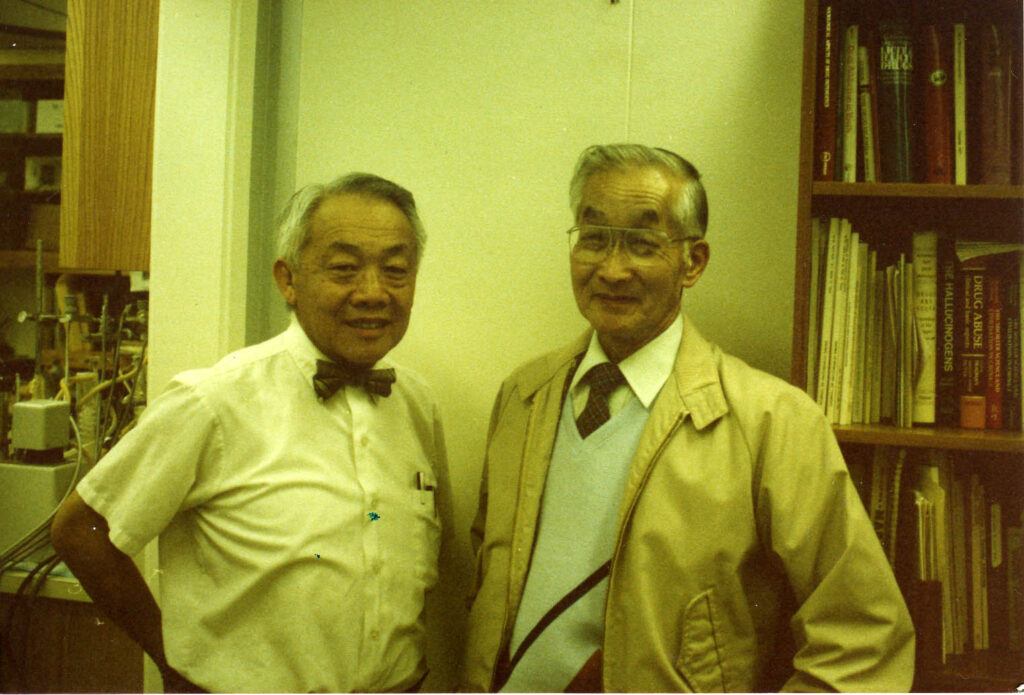
E. Leong Way and Harry Iwamoto, UCSF School of Pharmacy Class of 1938, March 10, 1986.
All sorts of documents made their way to the archives. Several of his publications and publication listings; various correspondences with other faculty members and students; notes and slides from his own lectures; even invitations and party photos! Work and play all mingle together in the collection to form the personal history of this astounding individual. His files dictating his time and effort spent towards the betterment of the UCSF School of Pharmacy and even the world of pharmacy as a whole are now preserved in UCSF’s extensive and detailed archives, where they shall most certainly remain safe and sound.
For more information please see the library catalog record and finding aid for the Way papers.
 Alex Giacomini was born and raised in the San Francisco Bay Area. She is vastly interested in writing and the humanities, and is currently a communications intern in UCSF’s School of Pharmacy. Alex is a rising senior at UC Berkeley, where she is working to attain her Bachelor of Arts in English Literature.
Before me there stood a great, big wall. An obstacle. A fortress. Well, metaphorically speaking, in any case. However, the five archival boxes full of various documents and files seemed as large as the tallest gate to me. Being a lowly intern, I must admit that I was a bit intimidated. After all, it was my responsibility to sort and organize all of these files.
The documents all pertained to the life and career of Dr. E (‘Eddie’) Leong Way, one of UCSF’s oldest alumni, and a great contributor to the understanding of opiate addiction and reliance. Unfortunately, their previous keepers did not properly store the files. They were in some small state of disarray, stuffed in varying folders and envelopes, stacked on top of each other, and even, in some cases, in incorrect boxes.
It was my job to remove the files from their initial place and sort them properly. I took them out of their different folders and placed them in official, archival ones, meant for preserving and protecting files more efficiently than other folders. Each folder must be labeled and numbered properly as well. After that, they are to be placed in official, archival boxes. And, lastly, I had to write up the inventories for each of the boxes.
It was a long, time-consuming task, requiring precision and a good deal of attention. Admittedly, it was a bit frustrating at times. However, that did not prevent it from being a great experience. It was fascinating to get insight into the work required in the archives. More importantly, it helped me understand the hard work others put into these tasks and others, as well as appreciate the importance of preserving and organizing the archives affectively and efficiently. If I were to be perfectly honest, I wouldn’t trade the experience for anything.
For more information please see the library catalog record and finding aid for the Way papers.
Alex Giacomini was born and raised in the San Francisco Bay Area. She is vastly interested in writing and the humanities, and is currently a communications intern in UCSF’s School of Pharmacy. Alex is a rising senior at UC Berkeley, where she is working to attain her Bachelor of Arts in English Literature.
The UCSF Archives & Special Collections would like to announce the opening of the new exhibit, “Eric L. Berne Archive: The Birth of Transactional Analysis.” This exhibit marks the conclusion of the first phase of the Eric Berne Archive Processing project.
Eric L. Berne (1910-1970) was a practicing psychiatrist, lecturer and author. Best known for his development of the theory of Transactional Analysis, Berne published dozens of scholarly articles in the field of psychoanalysis and was the author of eight major books, including the bestseller Games People Play.
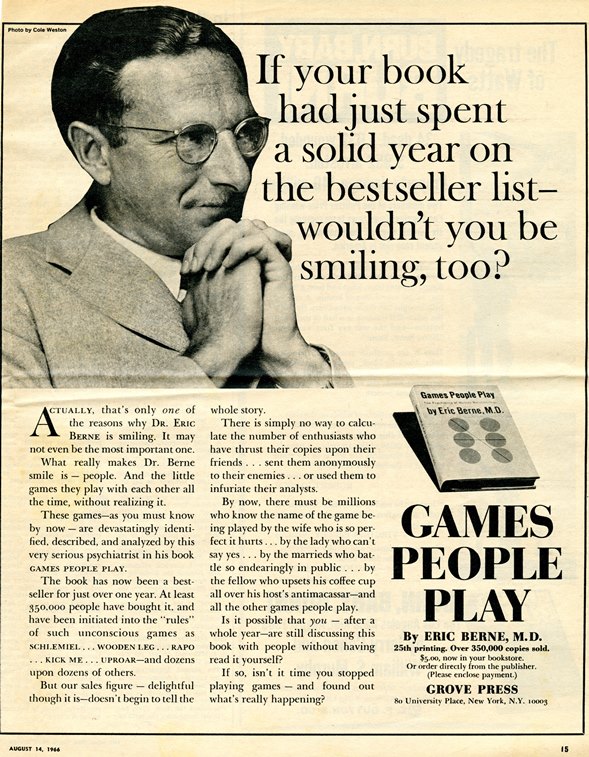
Advertisements for Games People Play, the New York Times Book Review, August 14, 1966. Eric L. Berne papers, MSS 2005-08, box 4, folder 21 UCSF Archives & Special Collections.
The materials in the Archive were created by Dr. Berne (1910-1970) and by the organizations he founded: the San Francisco Social Psychiatry Seminars (SFSPS) and the International Transactional Analysis Association (ITAA). The Archive holds Berne’s personal and professional papers, including correspondence, writings, notes, conference programs, administrative records, photographs, and audio-visual recordings.
In the past nine months (September 2013-May 2014) project archivist, Kate Tasker has been working diligently to process six existing collections and two recently added accessions. As a result of this effort six detailed finding aids for the Eric Bern Archive consisting of 77 boxes or 41.8 linear feet were added to the Online Archive of California. Kate also organized and compiled an inventory for the Eric L. Berne Rare Book collection that includes over 300 books from Berne’s personal library and copies of his published works. With the help of our cataloger, Bea Mallek, these volumes were added to the UCSF Library catalog and can be consulted in the Archives & Special Collections reading room.
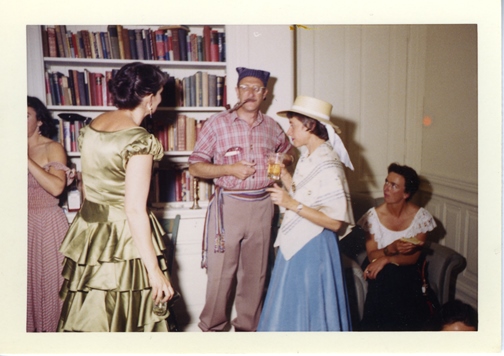
Costume party, August 1959.Eric L. Berne papers, MSS 82-0, box 2, folder 10 UCSF Archives & Special Collections.
Another important achievement was the digitization of more than 400 unique documents, containing Eric Berne correspondence (including letters from significant figures such as Alfred C. Kinsey, Paul Federn, and Karl Menninger), writings, educational records, lecture drafts, announcements and publications from the SFSPS and the ITAA as well as photographs. The Eric L. Berne digital collection, an educational portal containing information about Eric Berne, his studies and writings is now accessible to researchers and general public worldwide.
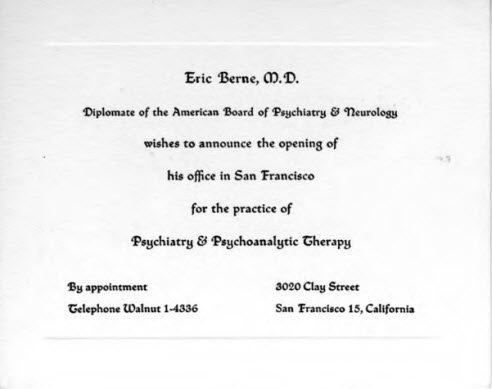
Announcement card for the opening of Berne’s San Francisco office, undated. Eric L. Berne papers, MSS 2003-12, box 3, folder 4, UCSF Archives & Special Collections.
The exhibit highlights selected artifacts, photos and documents from the Eric L. Berne Archive at UCSF.
The visitors will be able to view Berne’s correspondence concerning the design and promotion of the board game “Games People Play” and a fully intact game set, edited typescript of his first book The Mind in Action, his glasses, an announcement about the opening of his practice in San Francisco, a selection of English and foreign language
editions of his book Games People Play and numerous photographs.
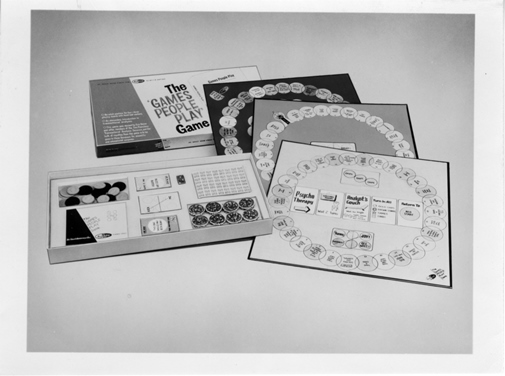
Photograph of the components of the Games People Play board game, based on Eric Berne’s best-selling book of the same title. Eric L. Berne Papers, 1929-1970, MSS 2005-08, box 4, folder 20, UCSF Archives & Special Collections.
The Eric L. Berne Archive is housed in the UCSF Archives and Special Collections. Detailed processing and digitization for these materials were made possible by generous support from 23 TA Associations worldwide and many individual donors through the ITAA. The UCSF Archives will continue working with the ITAA and its supporters to secure funding for the digitization of additional items.
Please view the online companion for this exhibit on the UCSF library website.
The exhibit will be on view on the 5th floor of the Parnassus Campus Library, beginning August 8th, 2014.
As it’s the height of summer, that time of year when many of us head outdoors a bit more often, we thought we’d highlight a first edition from our rare book collection that addresses a potential hiking hazard– snake bites.
Dissertatio prima [et secuna] de theriaca in officina Christophori Heerford Sen. Pharmacop. was published by Matthias Godicchenius for Petrus Hauboldus in Copenhagen, 1671. The volume is composed of two dissertations on snake poisons and their antidotes, issued from the laboratory of two Copenhagen pharmacists. The manner in which Bartholin approaches the topic is of particular significance as it assumes that blood circulates throughout the body. He was one of the earliest advocates of Harvey’s theory of blood flow.
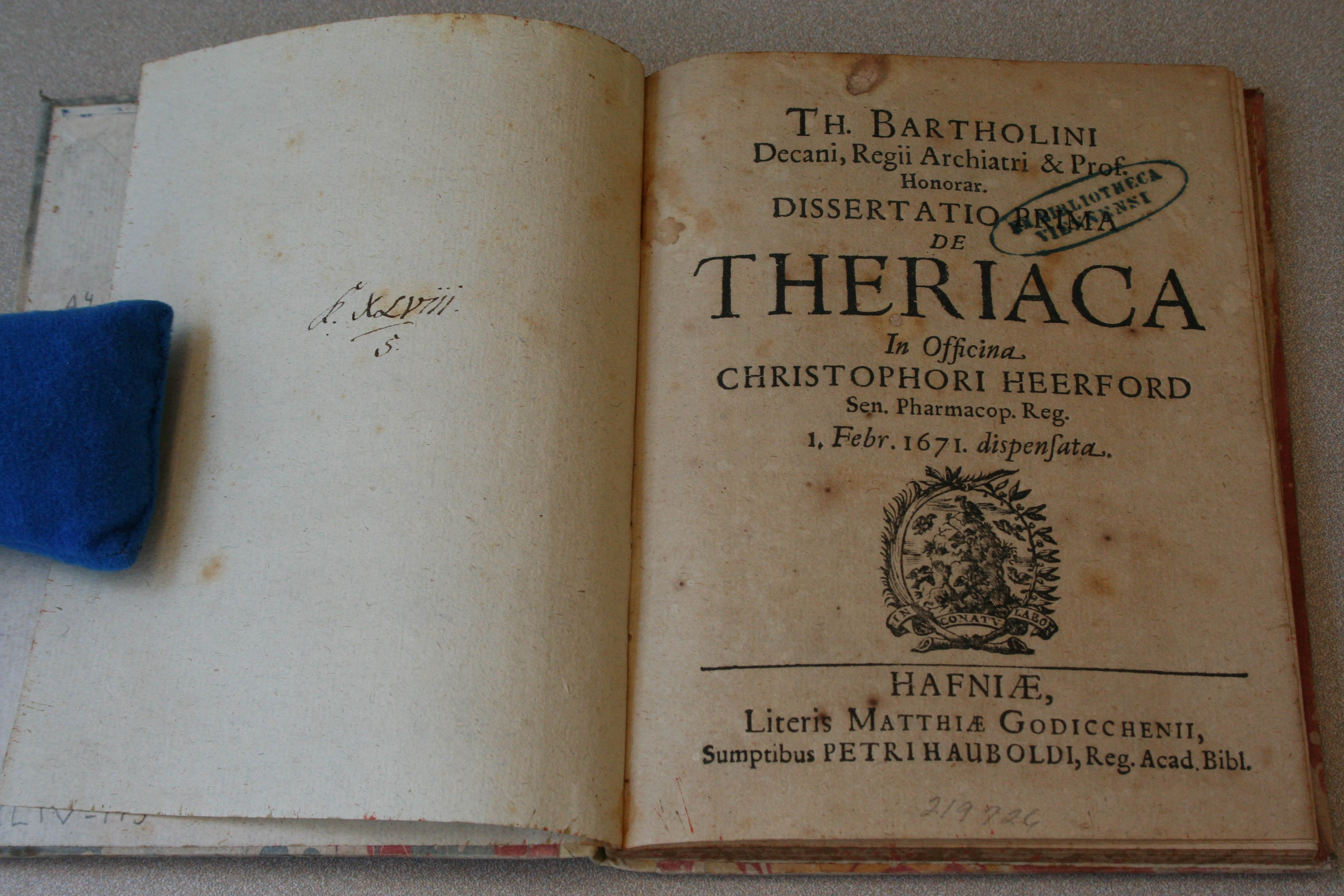
Thomas Bartholin was no slouch himself. He discovered the lymphatic vessels, contributed to anesthiology research, and came from an utmost scientific family that can boast pioneering work in the olfactory nerve, light ray double refraction, and discovery of Bartholin’s gland.
We hope you’re all enjoying the summer. Be safe and remember that even breeches and stockings may not protect you from everything.
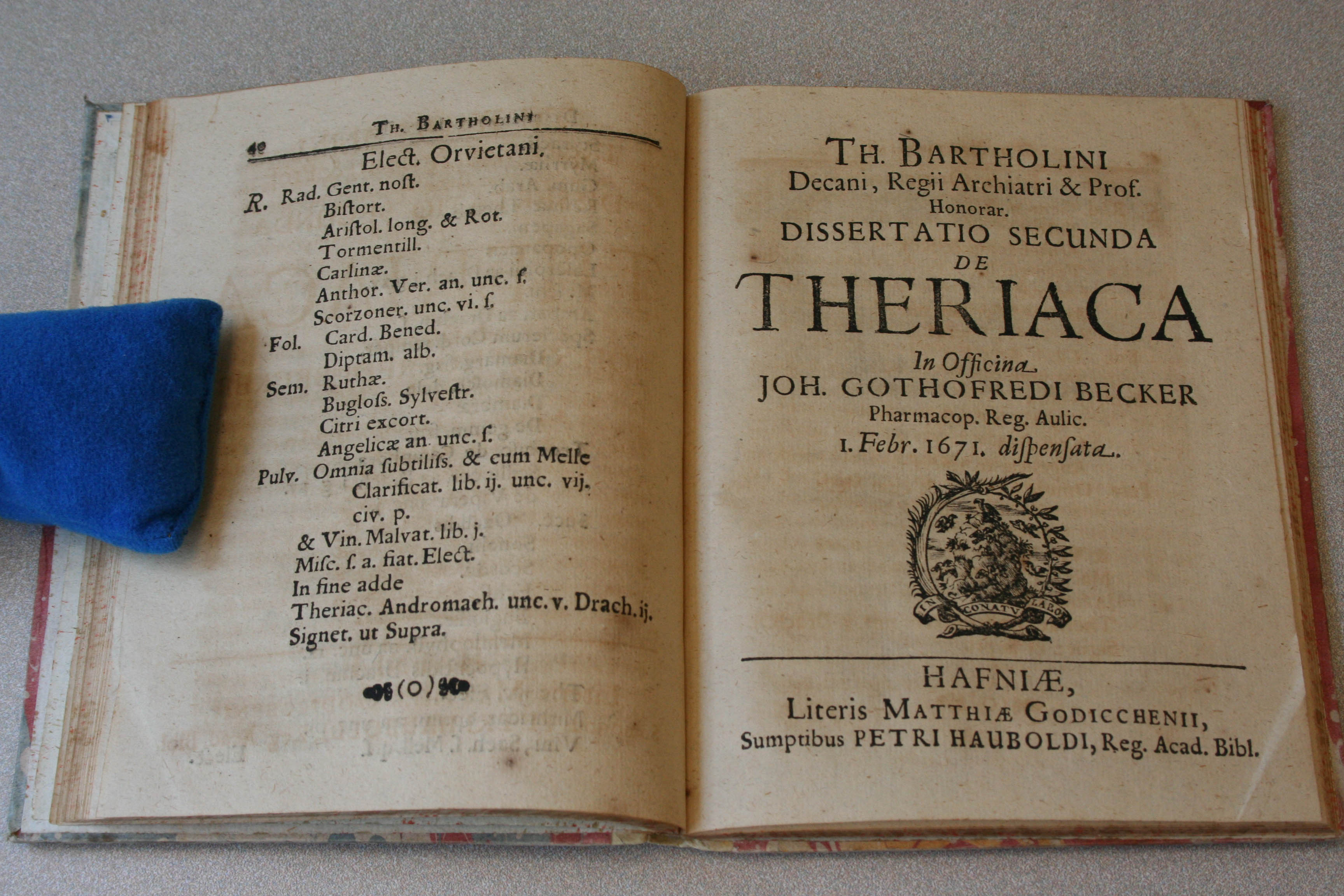
![Dissertatio primae [et secunda] de theriaca in officina Christophori Heerford, 1671](https://broughttolight.ucsf.edu/wp-content/uploads/2014/07/Bartholin_3.jpg)
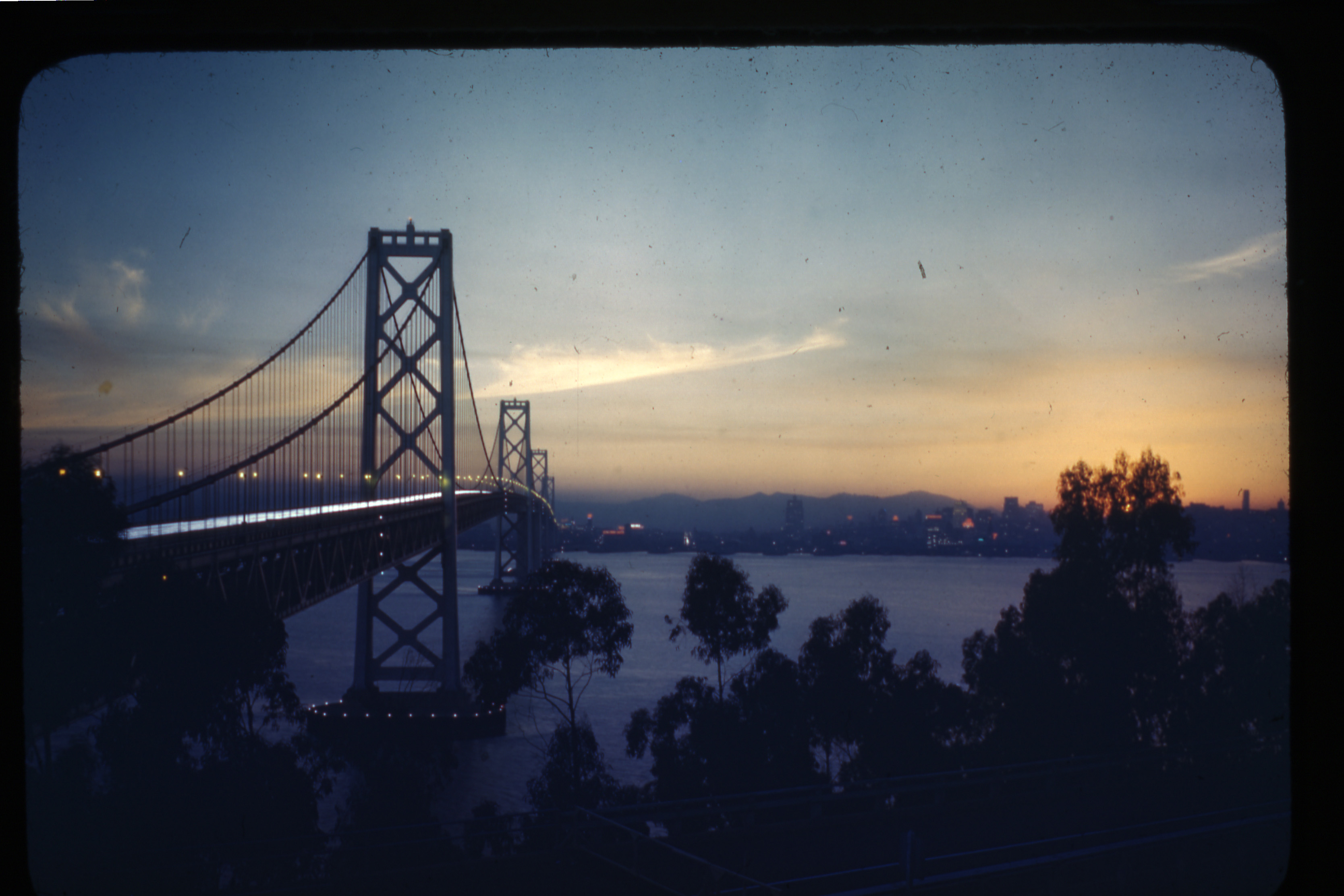
Bay Bridge at dusk, 1947, MSS 2011-23
A slide of the Bay Bridge at dusk in 1947 from the Robert L. Day collection, MSS 2011-23.
Hope you all have a wonderful holiday weekend!
As always, we’ve been working to make more and more collections accessible for research. The following are additions to the catalog over the past few months. Subject highlights include UCSF history, neurology, tobacco control, and stem cell research.
Contact us if you have any questions or would like to learn more. Don’t hesitate to use the calendar on the right to make an appointment to use collections!
AR 2002-18 University of California, San Francisco School of Medicine — Office of the Dean videotape collection, 1991-2003: Videotapes of lecture series, including Dean’s Research Seminar Series (DRSS), Galante lectures, and other special lectures/symposia. Also includes State of the School addresses, faculty meetings, academic senate meetings, award ceremonies.
AR 2012-12 University of California, San Francisco School of Dentistry records, 1952-1982: The papers of the UCSF School of Dentistry include: Newsletters of the Alumni Association of the University of California College of Dentistry, 1952-1980; Programs of the annual meeting of the Alumni Association of the University of California College of Dentistry, 1956-1977; Alumni Association of the University of California College of Dentistry by-laws and directory, 1974, 1981; CSEA UCSF Newsletter, 1956-1958; UCSF Alumni Association newsletter, 1982; UCSF magazine, 1982 Medi-Cal yearbooks; 2 photographs of School of Dentistry faculty and employees.
MSS 2010-16 Guenter B. Risse papers, 1987-2009: Papers relate to Risse’s research for his book “Mending Bodies, Saving Souls: A History of Hospitals” (Oxford, 1999). Materials include one binder with the original illustrations collected for the book, two folders with information about the origins of the illustrations and permissions to publish them, and one folder with correspondence and book reviews.
AR 2011-13 University of California, San Francisco School of Nursing, Master’s Entry Program in Nursing records, 1988-1991: The collection contains materials relating to the UCSF School of Nursing Master’s Entry Program in Nursing (MEPN) dated from 1988-1991. Papers include grants, clippings, promotional materials, various records from the program ranging from development to accreditation.
MSS 2011-18 Rheba Fradkin (de Tornyay) papers, 1946-1954: Collection includes photographs, nursing school application, reference letters, and clippings pertaining to Mount Zion School of Nursing graduate Rheba Fradkin (de Tornyay), the nursing school yearbooks, issues of NOIZ and Bib & Apron (1953-1954), announcements, pamphlets and recruitment brochures.
AR 2013-02 University of California, San Francisco School of Medicine Office of the Dean records, 1999-2012: Records include photographs, negatives, slides, contact sheets, CDs, and DVDs from the School of Medicine Dean’s office.
MSS 2012-29 Marilyn Reed Lucia film, 2012: The collection contains the film “Steadfast Purpose: the Life of Marilyn Reed Lucia, MD,” produced by Arc Light Digital Media in association with UCSF in 2012. The film chronicles the life of Dr. Lucia, graduate of UCSF Medical School– first in medicine, then in psychiatry– who taught and practiced at UCSF as a Clinical Professor of Psychiatry for more than forty years. The film begins in the 1950s and continues throughout Lucia’s life.
AR 2011-04 UCSF School of Medicine, Class of 1963 Alumni collection, 2009-2013: Collection includes the newsletter founded and edited by UCSF School of Medicine alumnus Robert Sherins, M.D. issues 2009-1013, and the 50th Reunion Memory Book for his class of 1963.
AR 2007-09 Renee Reijo Pera laboratory notebooks, 1996-2007: Collection contains the papers of Dr. Renee Reijo Pera’s laboratory. Materials include laboratory notebooks and research data. Dr. Renee Reijo Pera performed embryonic stem cell research and established UCSF’s embryonic stem cell program in 2003. She was the UCSF co-director of the human embryonic stem cell research center, and director of the training program funded through the California Institute for Regenerative Medicine.
AR 2003-23 Dorothy Bainton papers, 1970-2012: Records from the UCSF Vice Chancellor for Academic Affairs office relate to the tenure of Dr. Dorothy Bainton. Materials include records from the Advisory Committee on the Status of Women (CACSW); files from the UCSF League of Women; other materials related to the status of women at UCSF; a copy of “Report on Ishi’s treatment at the University of California, 1911-1916;” materials related to the Distinguished Alumnus Lecture presented by Dr. Bainton at the University of Rochester School of Medicine & Dentistry in 2012.
AR 2013-23 University of California, San Francisco. Metabolic Research Unit collection, 1966: Collection contains materials that relate to the UCSF Metabolic Research Unit (MRU) and includes four photograph prints depicting employees and researchers of the MRU and the inauguration ceremony and a 1966 School of Medicine Alumni-Faculty Association bulletin with an article about the history of the MRU from 1950-1966.
MSS 2013-20 Melvin M. Belli Tobacco Control papers, 1950-1999: Professional papers of Melvin M. Belli (1907-1996), a high-profile attorney in San Francisco, California, relate to actual and potential litigation matters pursued by Mr. Belli and colleagues against tobacco companies. Materials consist of various court filings, media clippings, correspondence, memoranda, publications, and others.
AR 2003-13 Department of Neurological Surgery records, 1958-2000: Records from the UCSF Department of Neurological Surgery include: publications, reports, correspondence, pamphlets, brochures, photographs, videotapes, and films.
MSS 97-04 Howard C. Naffziger papers, 1907-1983: The personal and professional papers of Howard Naffziger include correspondence, newspaper clippings, photographs, ephemera, certificates, military orders, notes, diaries, and artifacts. Subjects matters include Dr. Naffziger’s military experience in World War I and II, biographical information, his experiences at UCSF and his instrumental role in neurological surgery, and other work-related information.
 Within 18 years of California Statehood in 1850, the University of California was established in Oakland (1868). Already well-known in San Francisco were 2 private medical colleges, Cooper Medical College, which later was aligned with the University of the Pacific and then became the Stanford School of Medicine, and Toland Medical College, which first offered classes in 1864. Within 9 years (1873), Hugh Toland gifted the University of California with the school buildings and property in North Beach across from the San Francisco City and County Hospital. Continue reading
Many of us would assume that the vegetarian diets and other trends in eating one hears of so often lately are a more recent fad– a preoccupation brought on by modern life. Or, especially for those of us in the San Francisco Bay Area, we’d perhaps date them to the 1970s. However, a pamphlet from the George Williams Hooper Foundation Administrative Records, 1882-1958, collection number AR 59-1, shows us that like many ideas, vegetarianism has been around longer than we have.
The following issue of The Vegetarian and Fruitarian from March 1932, published in Lewiston, Idaho, promotes ethics, ideals, culture, health, and longevity. It describes itself as “a fund of information as to ethical and physical reasons for choosing meatless foods– for an argument or debate this booklet fits in nicely– giving ammunition for proving that vegetarianism is sound and logical.”
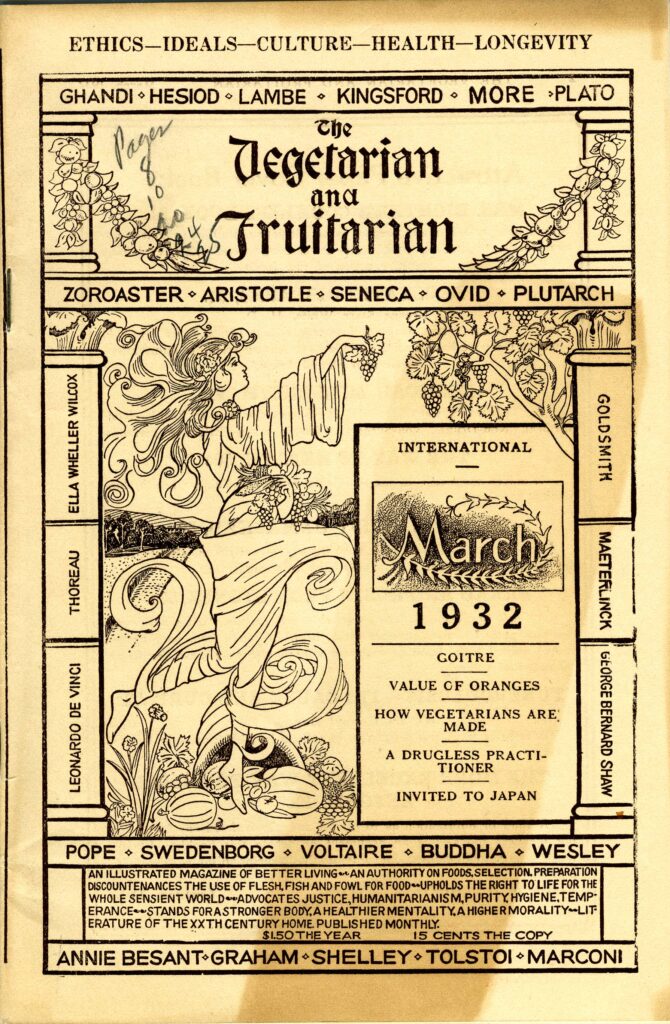
The Vegetarian and Fruitarian, March 1932
At the time, the vegetarian and raw food movements were, in part, tied to feminism. It was viewed as a way to free women from the confines of the kitchen and allow them to pursue other activities and interests. Notice the brief article “Vegetarian Soups for the Hurried Housewife” below on page 16. In the lower right hand corner of page 17, “Places to Visit When in Los Angeles” recommends raw food living “if you are wedded to the cook pot and would like to know of something different.” Similar to various lifestyle publications and articles today, it goes on to advise a vegetarian-friendly guest house in the area. Other vegetarian recipes appear across both pages such as Mock Hamburger– the parenthetical note for which is particularly interesting.
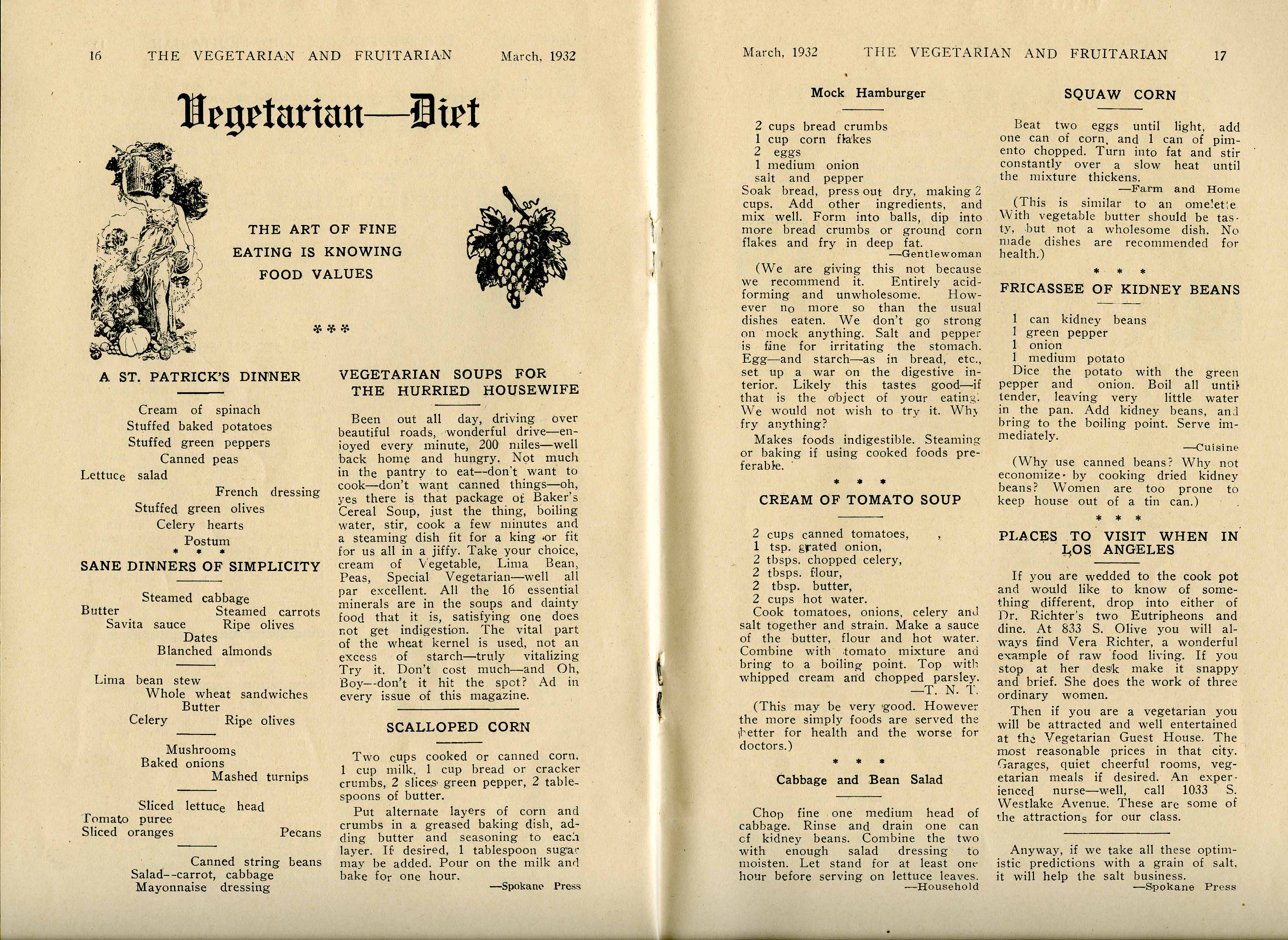
The Vegetarian and Fruitarian, March 1932, page 16 and 17. Hooper Administrative Records, AR 59-1.
Pages 14 and 15 give voice to two other current food and health trends that have history in the early 20th century– carbohydrates as devil and raw food. A Texas subscriber wrote in that she believed that the raw food diet had cured a number of her family’s ailments, including one of her daughter’s bad tonsils. The article on page 15, “Lowly Spud Seeks Help,” attempts to make a case for the healthfulness of potatoes to help bolster decreasing potato sales. It says, “Women have a mistaken idea. Potatoes, it is claimed, do not round out the figure.”
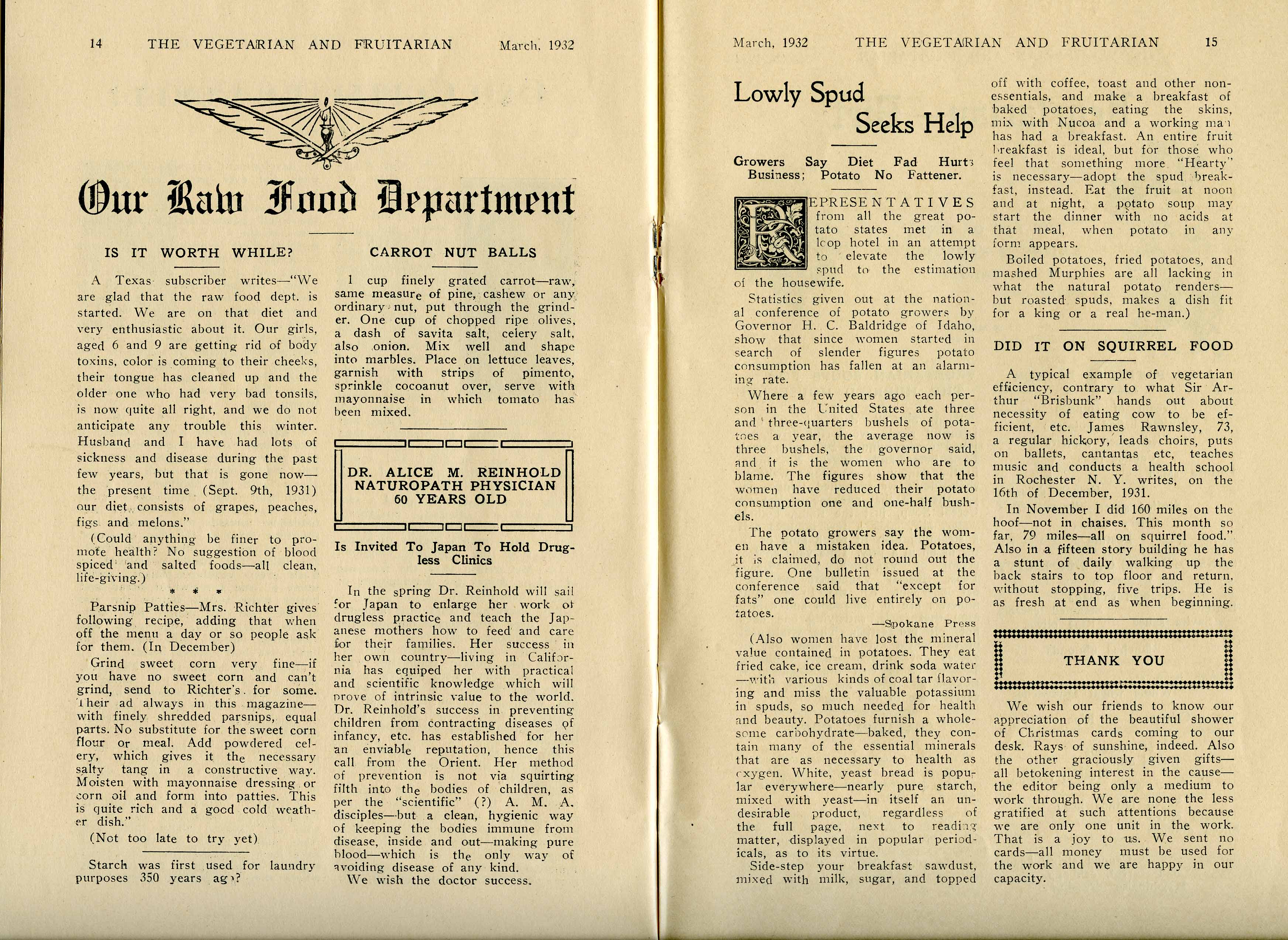
The Vegetarian and Fruitarian, March 1932, page 14 and 15. Hooper Administrative Records, AR 59-1.
For more information on the George Williams Hooper Foundation please see a brief history of the organization on the UCSF History Website and their current website. I’d also like to point you toward the post on Slate’s The Vault blog about 19th Century Vegetarian Personal Ads, which I found quite interesting.