2014 Winter Holiday Closure

The Archives and Special Collections will be closed from Wednesday, December 23, 2014 through Thursday, January 1st, 2015. We will reopen on Friday, January 2nd.

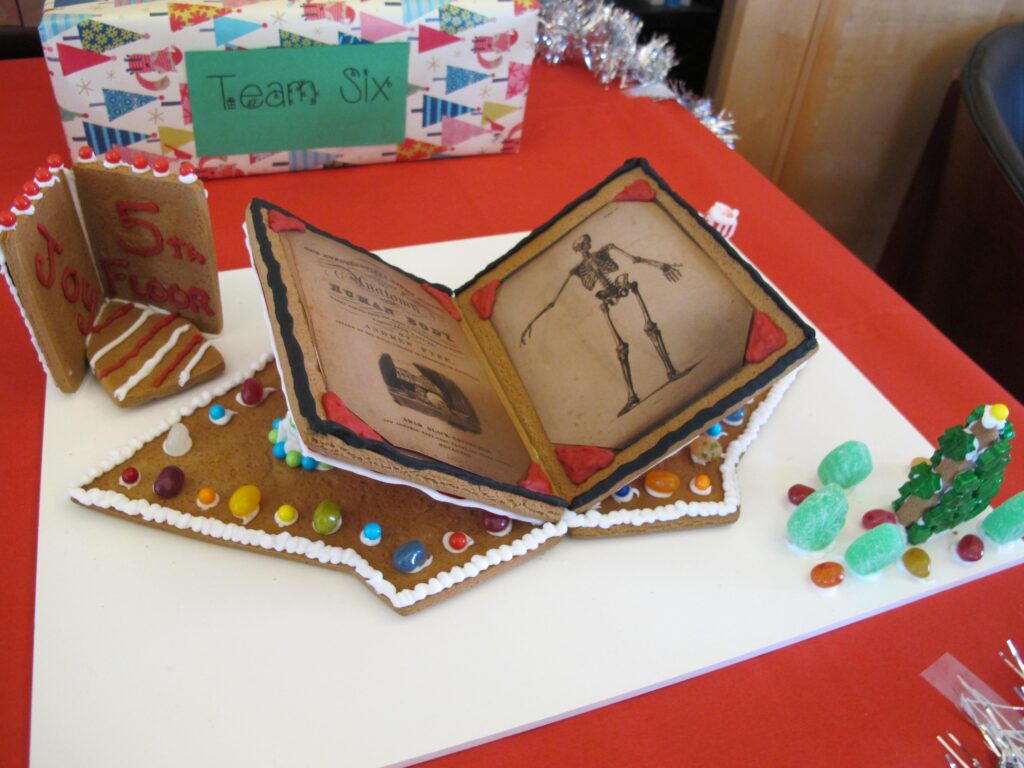
Gingerbread version of The Anatomy of Human Body: Illustrated in One Hundred & Fifty Eight Plates

Gingerbread version of The Anatomy of Human Body: Illustrated in One Hundred & Fifty Eight Plates by the UCSF Library 5th floor staff.

For our entry into the UCSF Library staff gingerbread house contest we used the pieces of the house to create a rare book in a cradle, specifically, we made a tastier version of Andrew Fyfe’s The Anatomy of the Human Body: Illustrated in One Hundred and Fifty Eight Plates, 1830, that we showed you earlier this fall on the blog

Happy holidays again! See you in the new year!

Holiday Wishes from UCSF Archives!

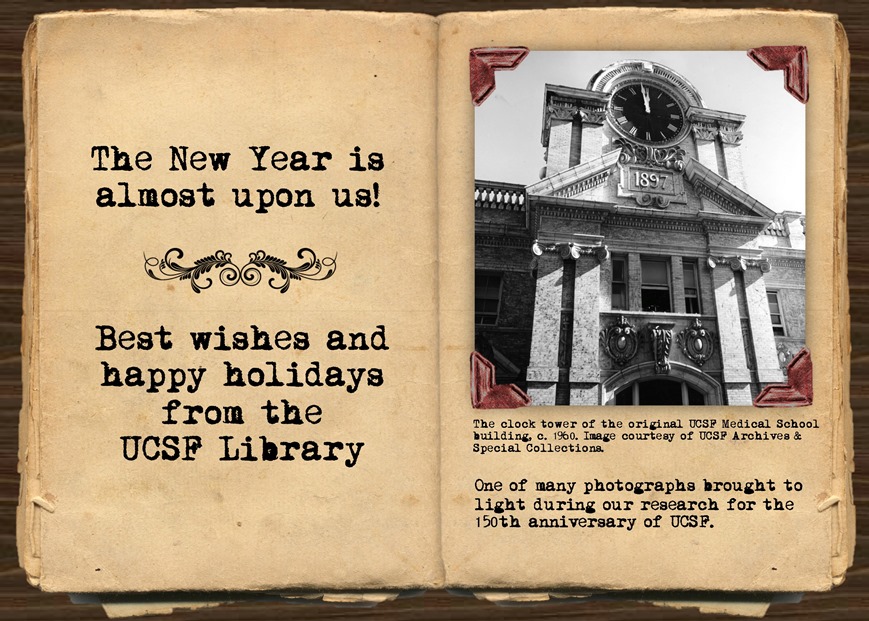
UCSF Library Holiday CardDear supporters and friends of UCSF Archives & Special Collections!

We would like to express our gratitude to all of you for your help in building our historical collections through donations of rare books, personal papers, and unique artifacts. Thank you for taking the time to read how UCSF Archives preserves the history of UCSF.
Over the past several years we have been providing archival documents, photographs and film footage to enrich the celebration of UCSF’s 150th Anniversary. This year we inaugurated archives lecture series and launched a Twitter account to share historical tidbits, provide updates on events, acquisitions and our diverse projects. Currently the archives team is working on several exhibits commemorating UCSF’s achievements that will be opened in 2015.

Looking forward to serving you in the New Year!

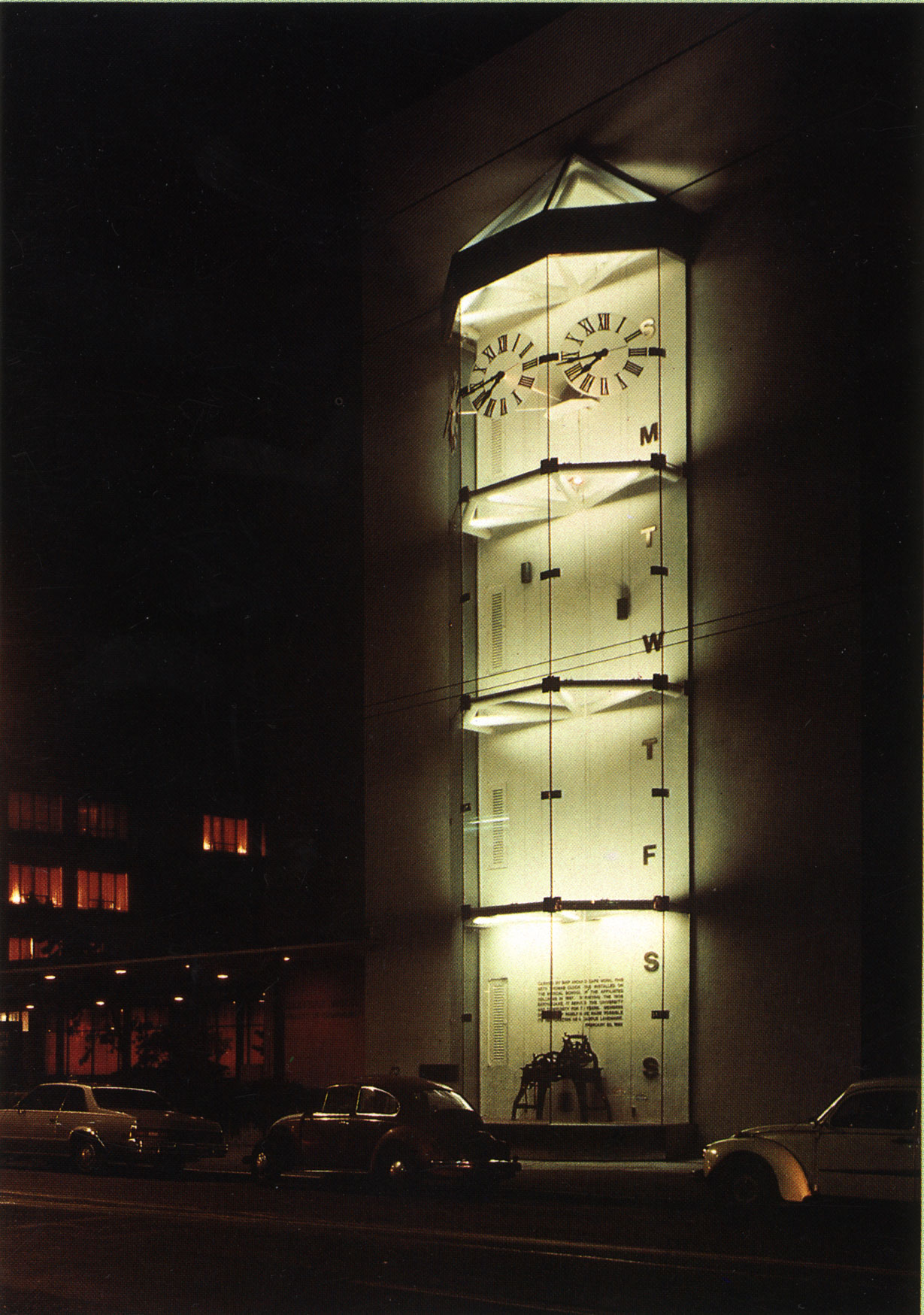
UCSF Clock Tower

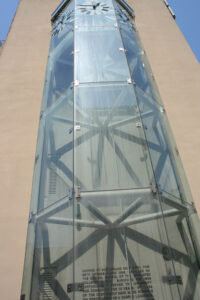
Millberry Union Clock Tower as it looks today.

Millberry Union Clock Tower, 2014

Have you ever noticed the large transparent clock on the exterior of Millberry Union? It looks like this:

I walk past it often without giving it a second thought, but the clock tower has quite an interesting history.

Often referred to now as the “Founders’ Clock,” it is also known as the “Toland Clock Tower” and “Seth Thomas Clock.” You may also have seen photographs of the Old Medical School building from time to time, with a large clock atop the center of the building– the same clock as Millberry’s clock.

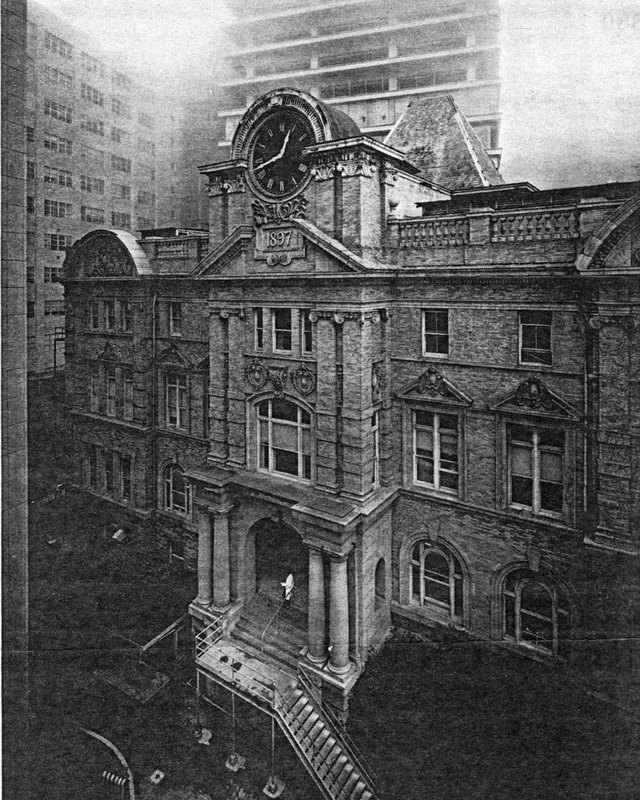
One of our rotating banner images here on Brought to Light depicts the old Medical Building, including the Seth Thomas Clock, through the lens of well-known photographer Ansel Adams. It’s a slice of this photograph:

toland-clock-tower_d68c000ac8

Ansel Adams, Clock Tower of old Affiliated Colleges building, with new structures in fog, August 1964

The above building was the College of Medicine, and the first building to have been erected on the Parnassus campus in 1897. Seth Thomas was a well-known clockmaker in Connecticut in the early and mid 19th century. The clock was brought to San Francisco via ship that traveled around Cape Horn, South America to be a crown jewel in the Affiliated Colleges campus. The image, taken in 1964, shows the old College of Medicine building surrounded by the more modern campus buildings of today in the background and on the left. When the old College of Medicine building was torn down in 1967, a group of “friends of the clock”, led by Alison Saunders, MD and assisted by Meyer Schindler, MD ’38, formed to ensure it’s safekeeping until it could be moved to a new location on campus. “We have salvaged the granite pillars and blocks as well as the clock from the old building that was a landmark on Parnassus Heights . . . ,” Dr. Alison Saunders declared in 1969 as chair of the UCSF Campus Court Development Commission.

The process to find the famous clock a new home took 14 years. Finally, in 1982 the inner-workings of the clock were reinstalled on Millberry Union, 500 Parnassus Ave, where it lives today.

Founders Clock, Millberry Union, circa 1982

Founders Clock, Millberry Union, circa 1982

Next time you’re walking around the Parnassus campus, take a closer look at the historic clock. It is a work of art worthy of our attention.

The inscription reads: “Carried by ship around Cape Horn, this Seth Thomas Clock was installed on the Medical School of the Affiliated Colleges in 1897. Surviving the 1906 earthquake, it served the University and community for 70 years. Members of the UCSF family have made possible its restoration as a campus landmark.”

Check out this article that details the historical inspiration for a new clock, “Saunder’s Clock,” in the Mission Hall courtyard of the UCSF Mission Bay campus.

Exploring the Archives for 150: Dr. Mary Olney’s Summer Camp for Children with Diabetes

In preparation for UCSF’s 150th anniversary celebration exhibits, we’ve been doing a bit of exploring in the vaults. For the next several months, I’ll be posting some of the treasures we’ve discovered!

In 1938, UCSF pediatrician Mary B. Olney founded the first wilderness camp in California for children with diabetes. Unlike many of her contemporaries, Dr. Olney believed that diabetic children could live active, healthy lives through proper disease management. Dr. Olney, known as “Doc” to her young patients, provided a fun, supportive space and encouraged campers to take control of their health. Bearskin Meadow Camp is still active today thanks in large part to the tradition of care and empowerment fostered by Olney.

Dr. Mary Olney on a hike, ca. 1940

Dr. Mary Olney on a hike, ca. 1940. MSS 98-64, box 1, folder 6

Dr. Olney graduated from UCSF in 1932. She completed her training in pediatrics at San Francisco General Hospital and was later appointed Clinical Professor of Pediatrics at UCSF. At the time of her death in 1993, Olney had served the UCSF community for over fifty years.

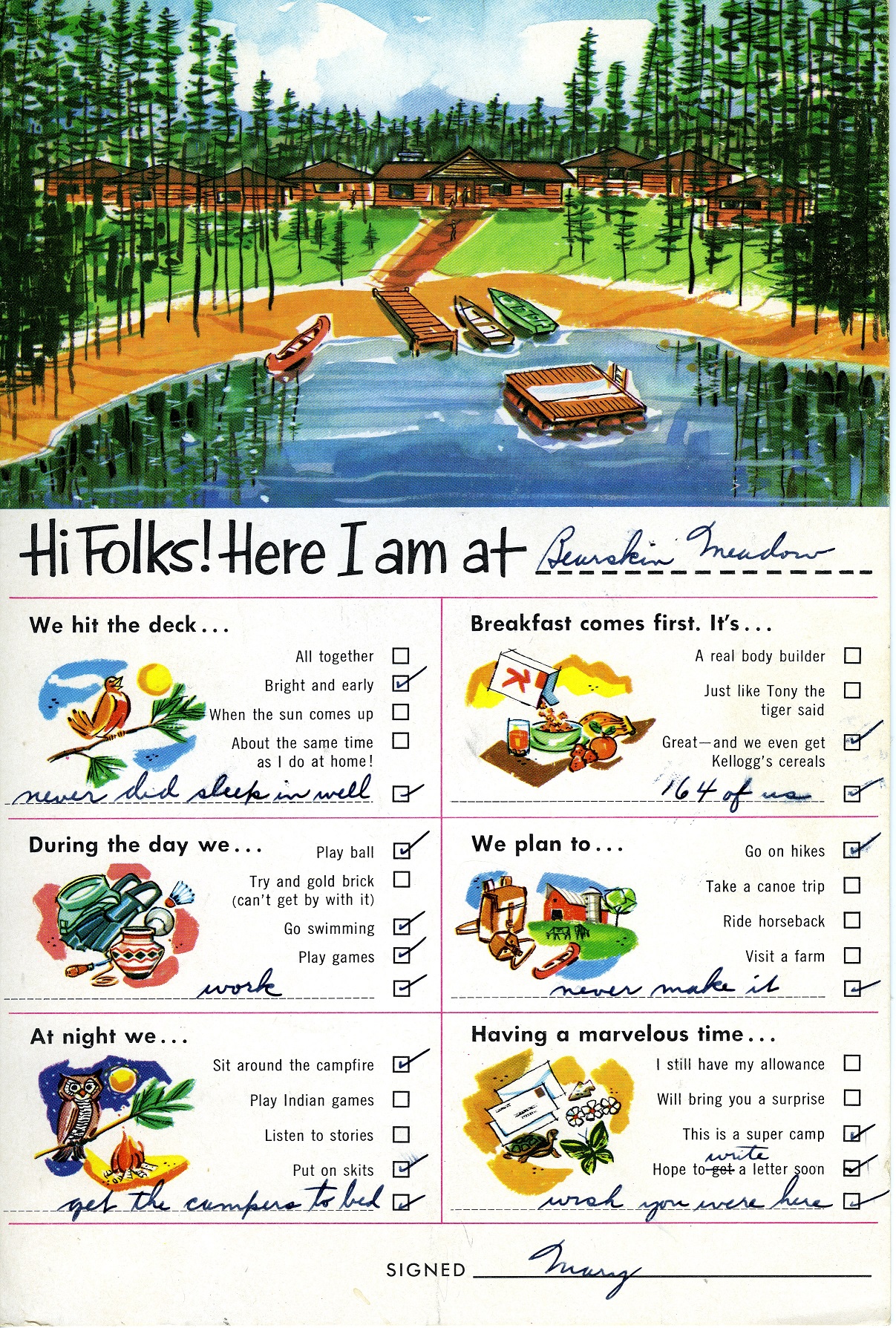
A postcard filled in by Dr. Mary Olney while at camp Bearskin Meadow. It is addressed to her father, 1961. MSS 98-64

A camp postcard filled in by Dr. Mary Olney while at Bearskin Meadow. It is addressed to her father, 1961. MSS 98-64, box 1, folder 27

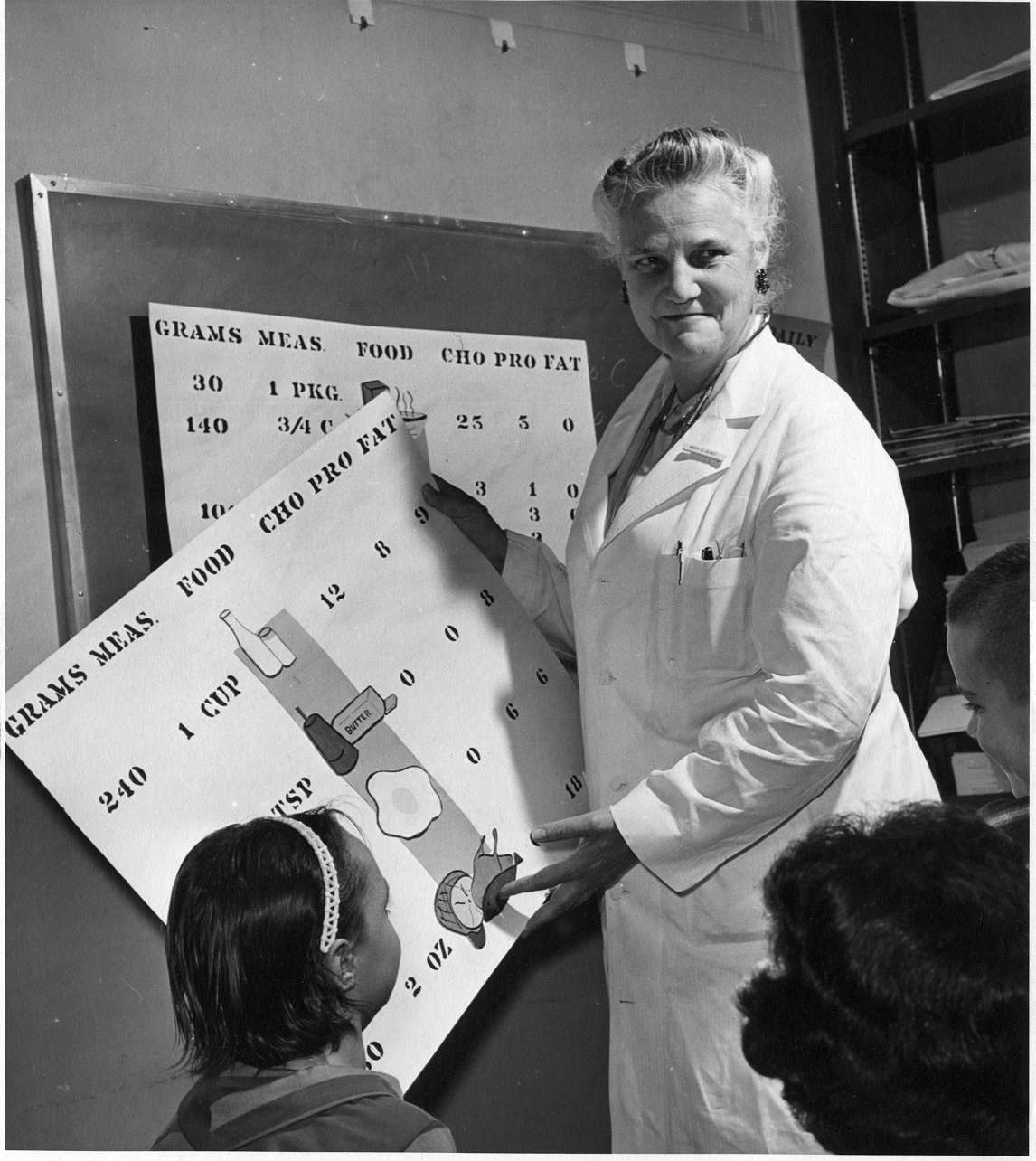
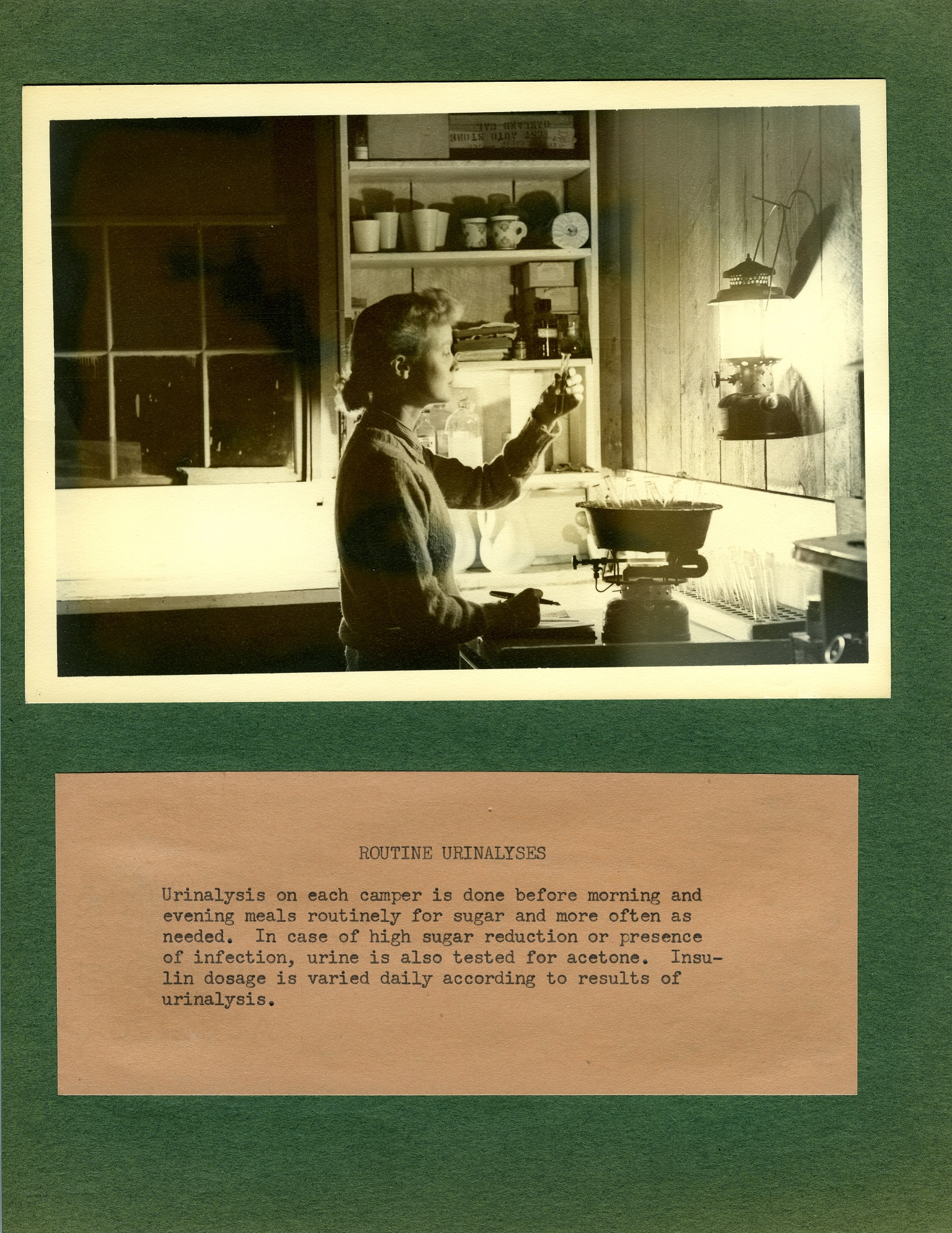
Olney’s first group of campers attended a two-week session at Los Posados in Napa County. The camp eventually developed into Bearskin Meadow, a permanent campsite located near Kings Canyon National Park. The camp welcomed boys and girls and provided coeducational activities. Diabetes management instruction focused on diet, exercise, and proper insulin administration.

Dr. Mary Olney teaching nutritional information to campers. MSS 98-64

Dr. Mary Olney teaching a nutrition class for campers. MSS 98-64, box 1, folder 6

Camp staff performing urinalysis. Photograph with original caption, perhaps from a deconstructed scrapbook. MSS 98-64

Camp staff performing urinalyses. Photograph with original caption, perhaps from a deconstructed scrapbook. MSS 98-64, box 2, folder 45

Olney and the counselors, many of whom were medical students, taught a holistic system of care that campers could take home with them.

Camp staff and counselors, ca. 1941. MSS 98-64

Camp staff and counselors, ca. 1941. MSS 98-64, box 1, folder 34

Alongside nutrition classes and medication instruction, campers took nature hikes, learned to swim, played sports, and sang campfire songs. As Olney later noted in a 1988 interview in the UCSF Alumni Faculty Association Bulletin, this physically robust approach to diabetes management differed dramatically from older systems. Olney remembered that when campers first arrived, they often “didn’t know they could do hiking because the old way of treating diabetes was to let the child go from school to home and sit in a chair until suppertime and then go to bed.”

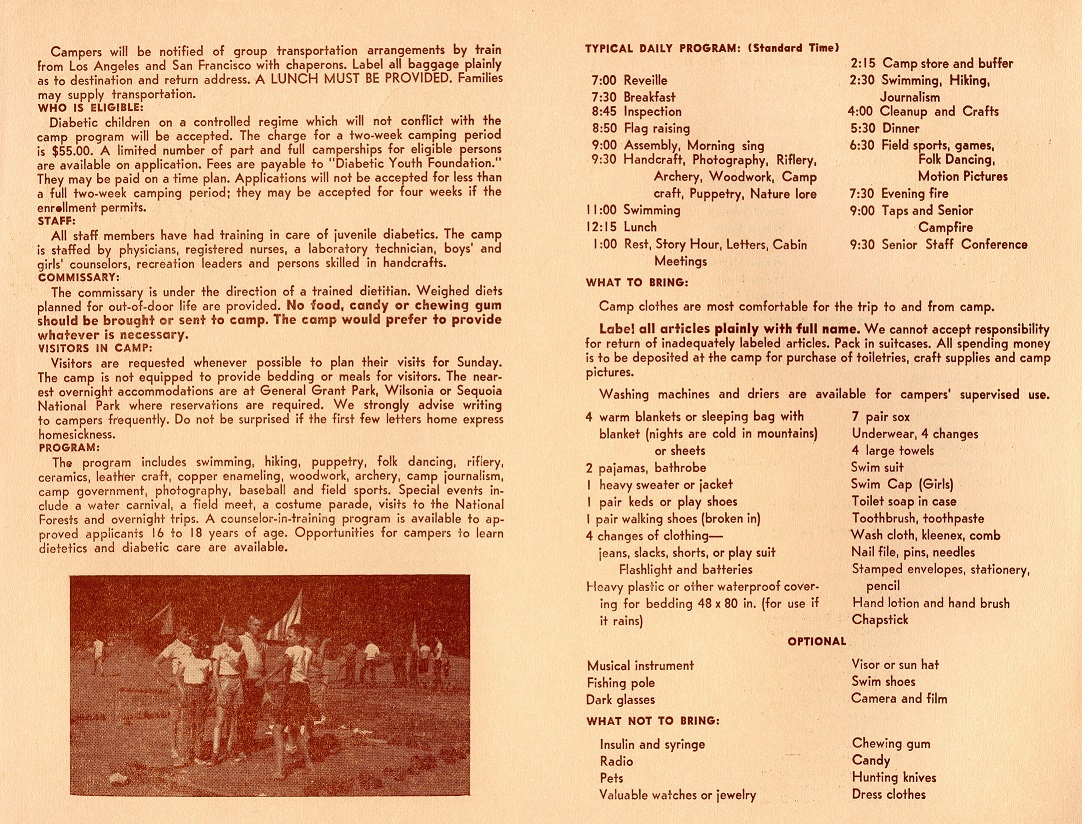
Camp announcement noting the different activities and a typical camp day, 1962. MSS 98-64

Camp announcement noting the different activities of a typical camp day, 1962. MSS 98-64, box 2, folder 77

UCSF continues to honor and support Olney’s work through the Mary B. Olney MD / KAK Chair in Pediatric Diabetes and Clinical Research. In the archives, we house the Mary B. Olney papers, MSS 98-64. The collection includes camp photographs, correspondence, meal plans, and publicity and fundraising material. It also contains records relating to the Diabetic Youth Foundation, an organization created by Olney and her longtime partner Dr. Ellen Simpson to help administer the camp and other services.

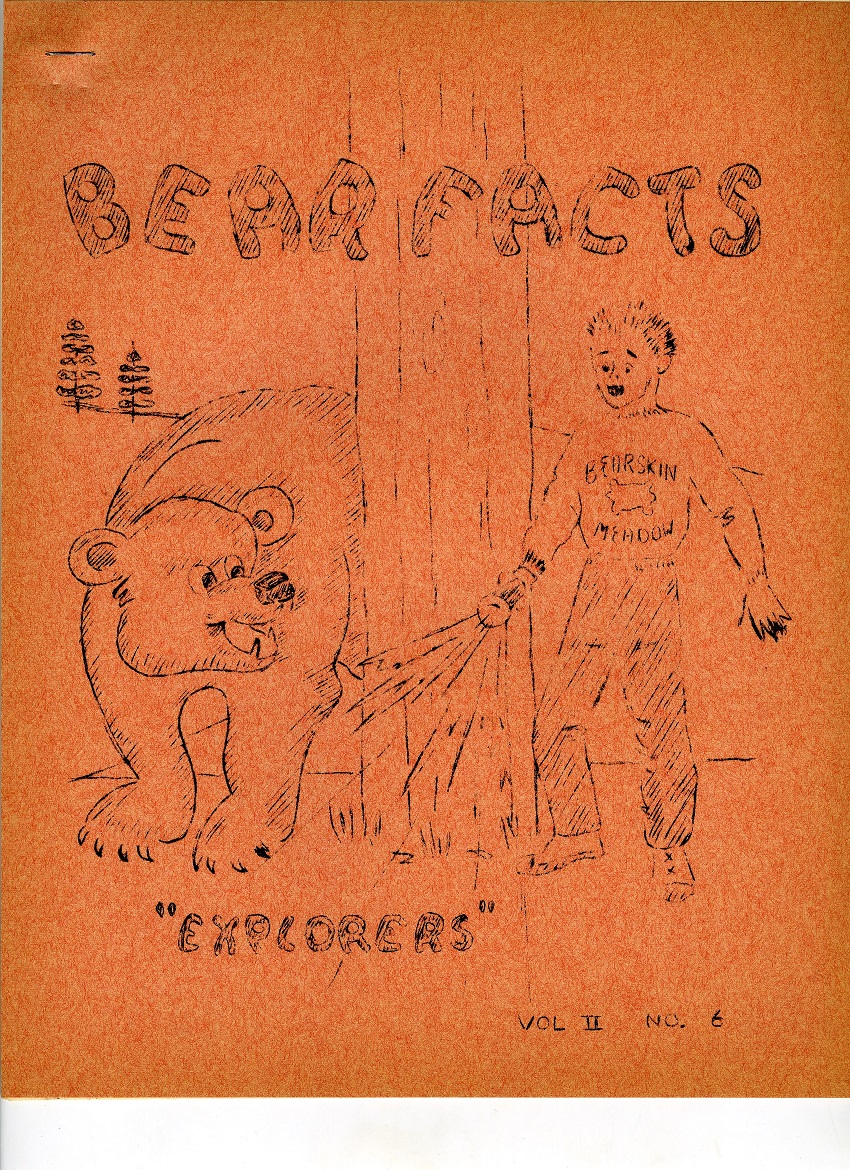
The cover image of Bear Facts, vol 11, no. 6, a publication created by campers and counselors at Bearskin Meadow. The Mary B. Olney collection includes numerous issues of Bear Facts.

The cover image of Bear Facts, vol II, no. 6, a publication created by campers and counselors at Bearskin Meadow Camp. The Mary B. Olney collection includes numerous different issues of Bear Facts. MSS 98-64, box addition 3, folder 4

To view more items from the Mary B. Olney papers, visit our digital collections!

Lecture now online: Shimkin’s “Lost Colony” (1947-1953)

The lecture Shimkin’s “Lost Colony” (1947-1953): Early Interdisciplinary Cancer Research at UCSF presented by Michael Thaler, MD, MA last month on October 13th is now available online free via the Internet Archive.

(It seems that Polina’s microphone wasn’t turned on; just be patient, the sound is fine for Dr. Thaler’s presentation.)

The Laboratory of Experimental Oncology (LEO) was the brain child of Michael B. Shimkin, a career U.S. Public Health Service physician and cancer research at the National Cancer Institute. LEO was established in 1947 at Laguna Honda Hospital at Laguna Honda Hospital, jointly administered by the NCI and UCSF. Speaker Michael Thaler, MD, MA explains how Shimkin created one of the first combined interdisciplinary clinical and basic science research units embedded in a medical school. In this setting, Shimkin introduced the patient release form and was instrumental in the establishment of universal guidelines for the ethical conduct of experiments with human subjects.

Dr. Thaler spoke as part of our ongoing UCSF Archives & Special Collections Lecture Series which serves to introduce a wider community to our holdings, provide an opportunity for researchers to discuss how they use this material, and celebrate clinicians, scientists, and health care professionals who have donated their papers to the archives.

Next, we will welcome Mark Honigsbaum, PhD to discuss Karl F. Meyer: California’s Forgotten Microbe Hunter on Friday, December 5th at noon in the Library’s Lange Room. Please join us!

World AIDS Day

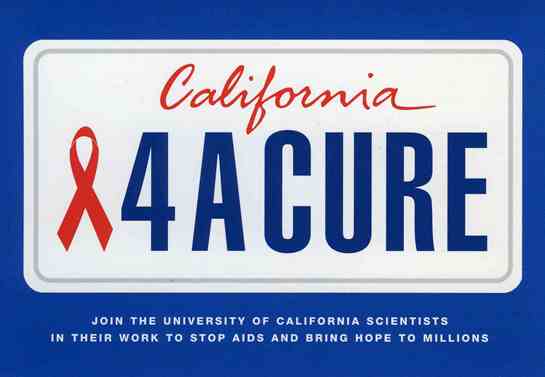
AIDS Research License Plate Program application form.

AIDS Research License Plate Program application form, UCSF Center for AIDS Prevention Studies (CAPS) records

UCSF Archives continues to collect and preserve AIDS History materials. Here is a list of recently cataloged collections that can be viewed in the reading room:
AR 2005-15, UCSF Center for AIDS Prevention Studies (CAPS) records, 1984-2004
AR 2007-14, UCSF AIDS Health Project records, 1983-2003
MSS 2001-04, Sally Hughes AIDS research collection, 1981-1997
MSS 96-32, Brooks Linton ephemera collection, 1983-1995

Thanksgiving recipes from Doctor’s Wives Association

The holidays are almost here… Are you still searching for a perfect recipe to amaze your guests and share with the family? Look no further! “Kitchen Consultations,” a cookbook which was put together in 1950 by the University of California Doctor’s Wives Association – a group of “health-minded, vitamin conscious women who used these recipes in their own homes.” This organization traces its origins to 1917 when its first members met and adopted the name “Ladies of the Medical Faculty of UC.” In 1925 the name was changed to “Doctors’ Wives Association of U.C.,” but the goals remained the same – working for the benefit of the hospital and especially pediatric wards. Later the major fundraising efforts were directed to Dr. Mary Olney’s Diabetic Youth Camp as well as amenities for patients, loan fund for students and the Founder’s Clock restoration.

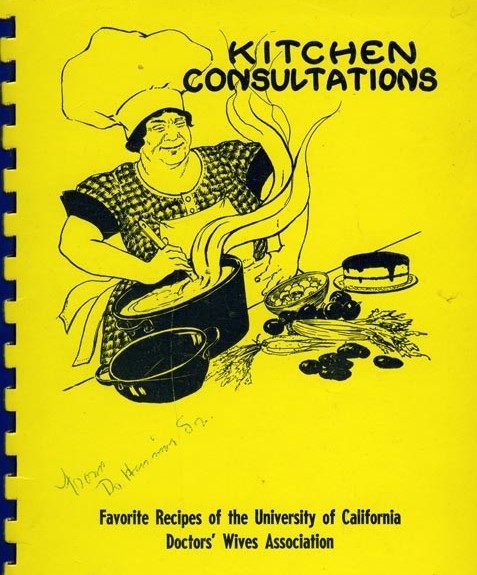
"Kitchen Consultations,” a cookbook compiled in 1950 by the University of California Doctor’s Wives Association

“Kitchen Consultations,” a cookbook compiled in 1950 by the University of California Doctor’s Wives Association

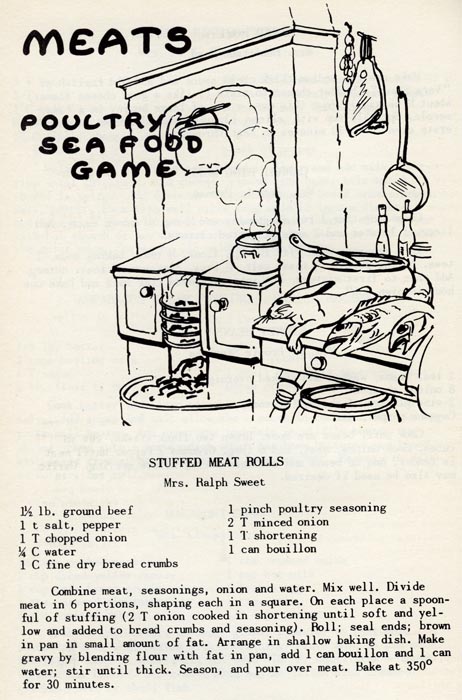
The exquisite artwork in the book was done by Ralph Sweet, professor of Medical Arts and Illustrations at UCSF Medical School.

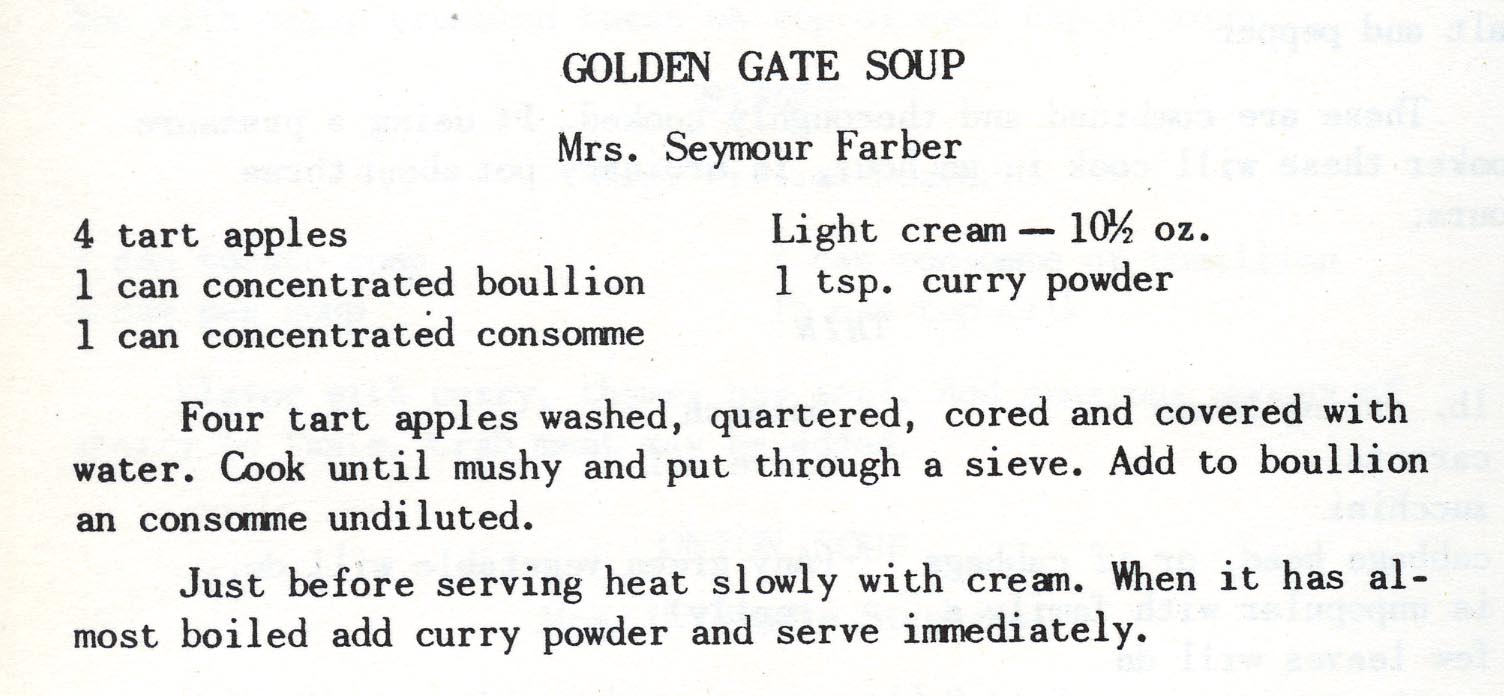
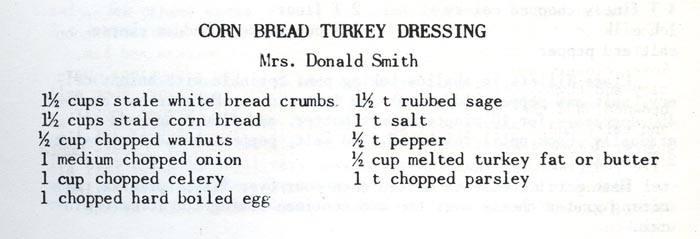
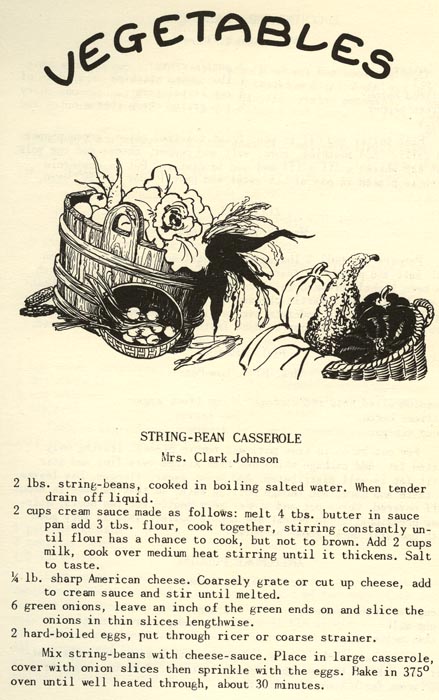
Here is a selection of recipes for a four course dinner…

dwa_cook_book_1950_gg_soup_sm

Golden Gate Soup recipe by Mrs. Seymour Farber

dsa_cook_book_1950_meat_rolls_sm

Stuffed Meat Rolls by Mrs. Ralph Sweet

dwa_cook_book_1950_cornbr_sm

Corn Bread Turkey Dressing by Mrs. Donald Smith

dwa_cookbook_1950_beans_sm

String-Bean Casserole by Mrs. Clark Johnson

dwa_cook_book_1950_pecan_sm

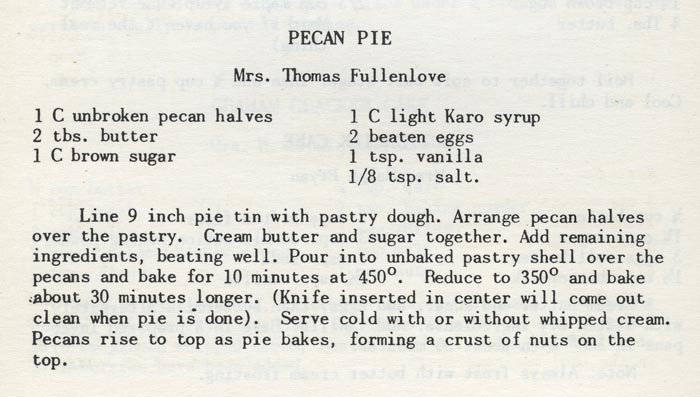
Pecan Pie recipe by Mrs. Thomas Fullenlove

Happy Thanksgiving and best wishes from the UCSF Archives team!

“Kitchen Consultations” cookbook is part of the Faculty Wives, University of California, San Francisco Records, 1948-87 and can be consulted in the archives reading room.

Through the Eyes of an Intern

IMG_2040_sm

Hi everyone, my name is Armani Fontanilla and I am an undergraduate student at the University of San Francisco interning at the UCSF Archives & Special Collections.

At the archives, I am currently tasked with the processing of small box collections, or the creation of box level inventories and the digitizing, and creation of, metadata for the archives that have yet to be placed into the virtual catalog. Other projects that I am potentially tasked with are research for the upcoming 150th Anniversary of UCSF on the level of researching stories, scanning images, and looking for documents, as well as helping with the vast inventory of the Medical Artifacts collection.
IMG_2025_sm

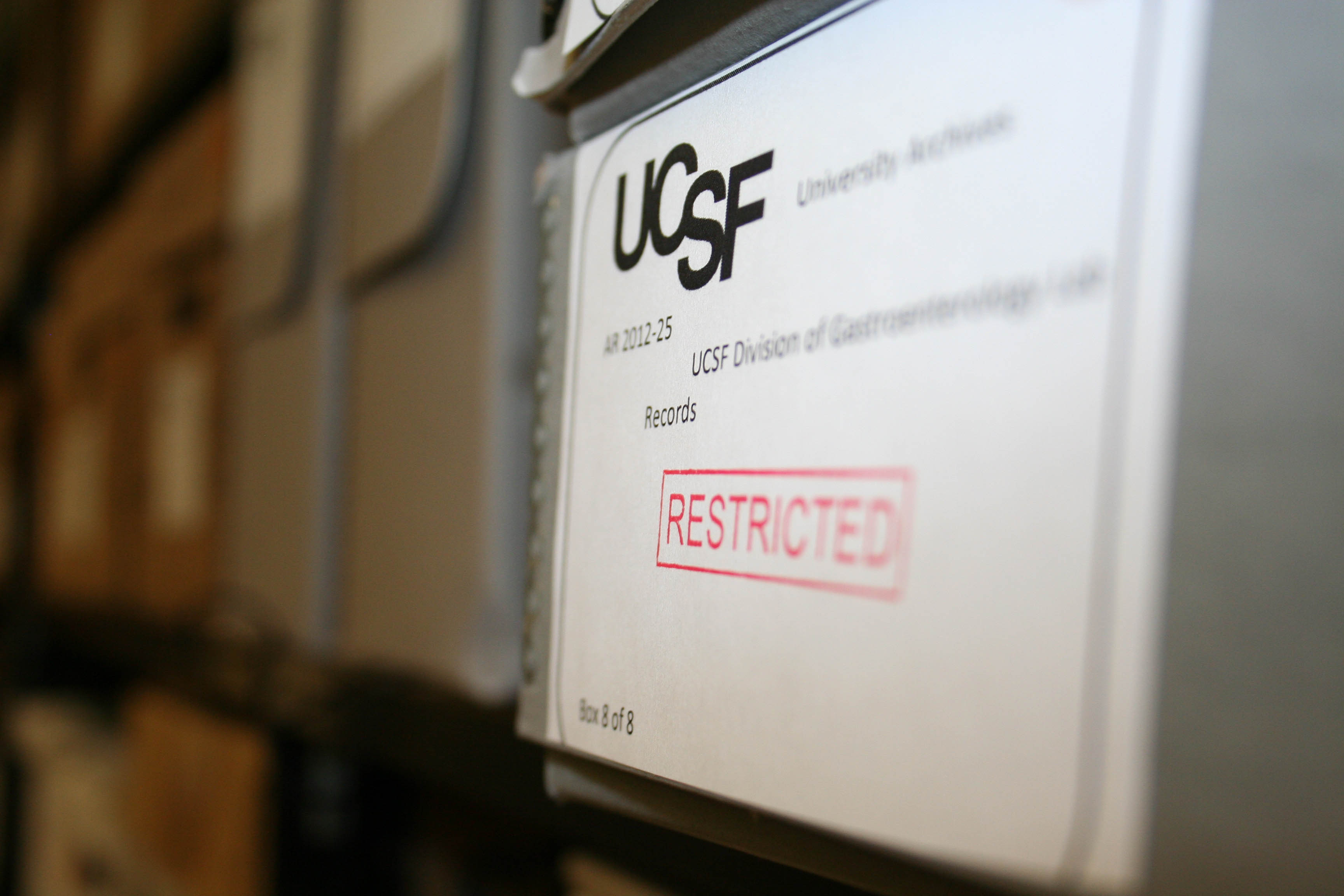
It’s restricted for a reason. We can’t reveal why. All you need to know is Maggie has the really cool “restricted” stamp. It’s actually really cool.

Even though the potential projects are only potential projects, my senior co-workers, Maggie and Kelsi have both taught me a lot in the projects that I am currently working on. For example, Kelsi has taught me about her work with the Medical Artifacts collection: How the UCSF catalogs have changed from one form to another, and that cross-referencing catalogs with each new edition that has come through the library archives since 1864, one also has to decipher the writings and annotations of previous archivists, as well as come up with new ways to reorganize the collections in our possession.

Maggie, on the other hand, has taught me how to do the projects that I am currently doing, as opposed to the potential projects that Kelsi lets me shadow every so often. She has taught me proper labeling procedure, and storage techniques, as well as projects that mirror the one that Kelsi is currently doing, which would be creating catalogs for documents in storage.
IMG_1984_sm

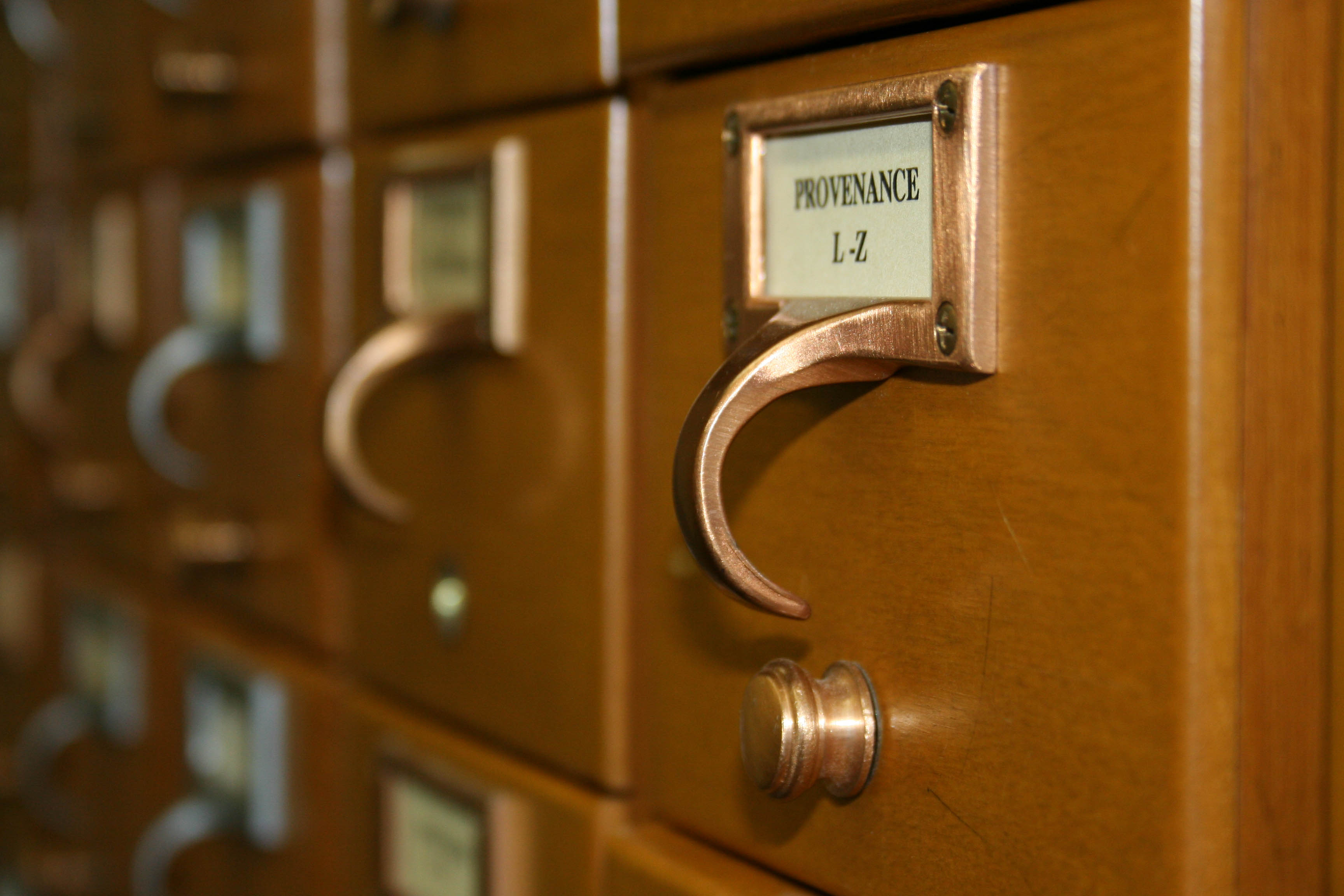
Cataloging kind of like this, but more modern.

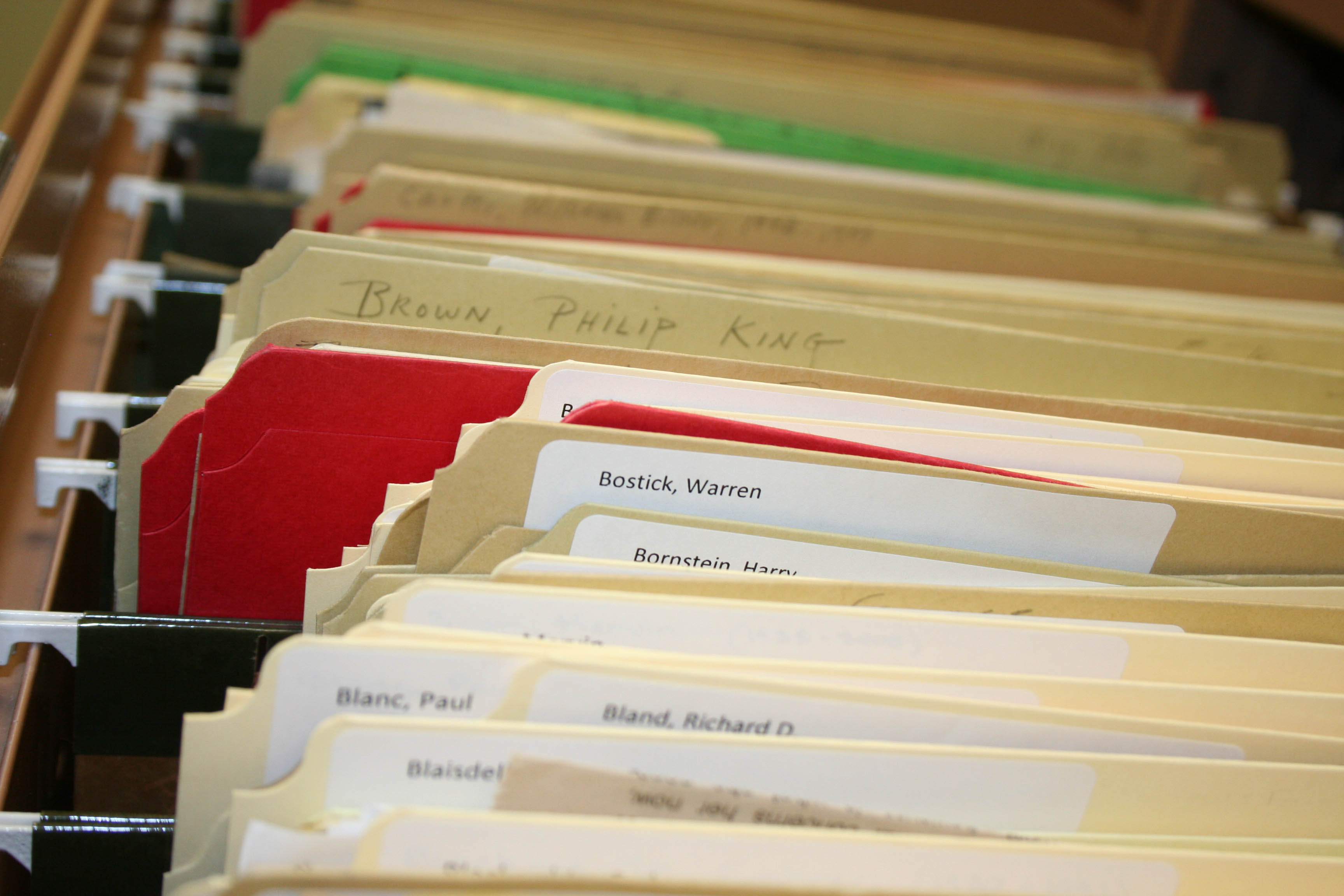
Finally, the first project (that I am still working on when I’m not being taught by Maggie or Kelsi, is the creation of a digital inventory of UCSF affiliates and members. Fortunately, most of the physical inventory is in English, and it is all on-site. Unfortunately, the physical inventory itself is not backed up – folders that are not archival standard need to be replaced, labels need to be printed out because of the inconsistent handwriting of previous archivists (and this intern’s), and more files need to be created for the ever expanding role of UCSF affiliated persons who are recognized in the news worldwide – from China, to America, to Brazil, to the Philippines, UCSF’s impact on the world is growing. And my first, and current job, is to help sort the files so that we can keep track of them for people to use and peruse in the future.
IMG_2043_sm

Before this data can hit the internet, I need make sure they’re all in order.

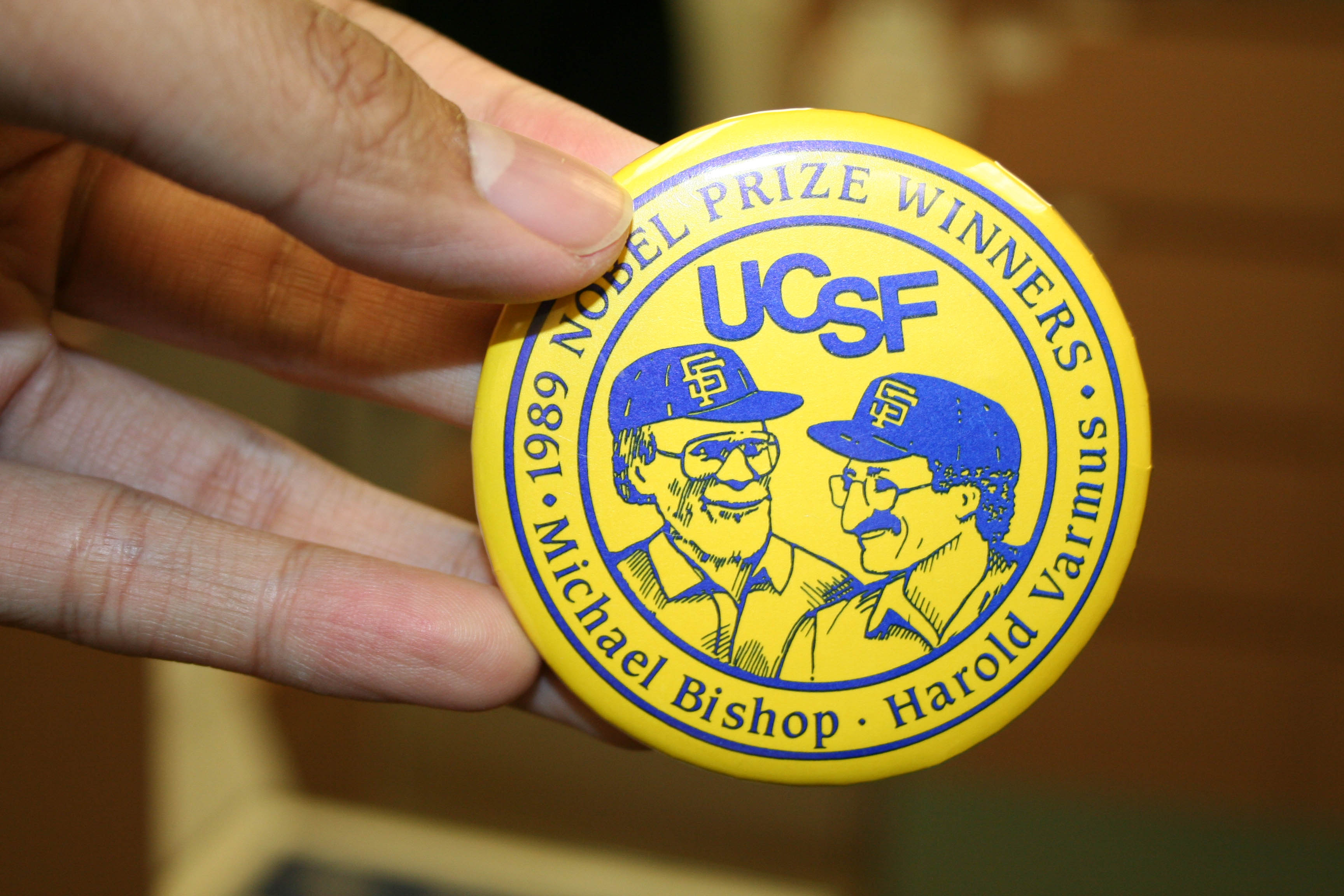
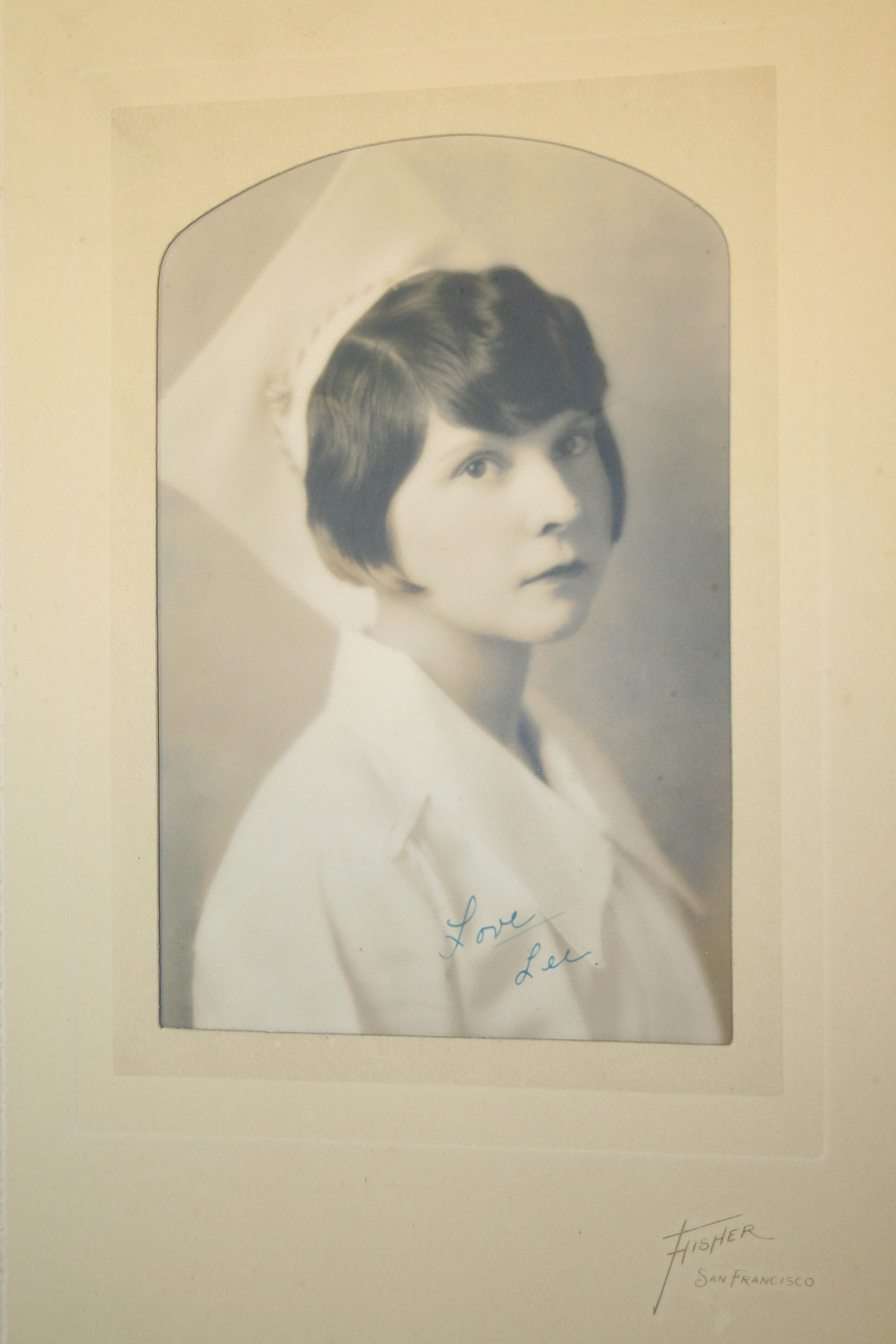
Within these jumbled folders, however, lie treasures that I am so excited to find. While often the files just contain one or two articles, some contain as many as ten plus! And these articles are often varied – they come in the form of obituaries, photocopied documents, magazine clippings, newspaper articles, biographies, and more! But instead of letting me describe them, let me show you some examples.
IMG_2045_sm

A button with 1989 Nobel Prize Winners Michael Bishop and Harold Varmus.
IMG_2052_sm

Brown, Leatha. School of Nursing, Class of 1928.

IMG_2009_sm

Holt A. Cheng, 1904. He was the first Chinese to be licensed to practice medicine in California after graduating from the College of Physicians and Surgeons in San Francisco. After returning to China, he established the Guang Hua Medical Society, the first medical college of western medicine established by the Chinese, for the Chinese, and the first medical school to accept female applicants.

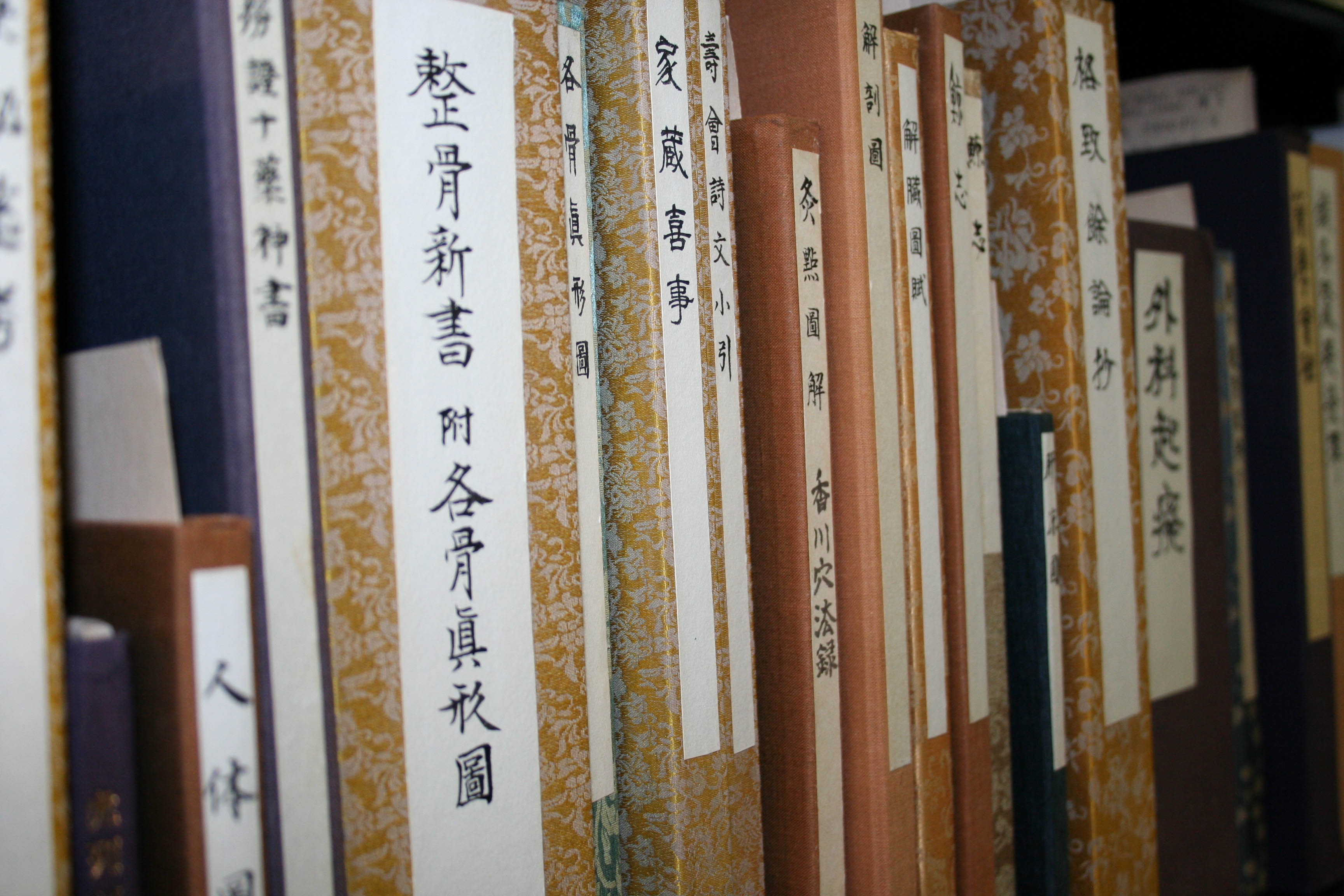
And finally, the UCSF archives are not only home to just Western schools of thought in medicine, but include Eastern Thought as well. On site and in a state-of-the art archival room, various Eastern texts in Chinese and Japanese are stored, either purchased by the Head Archivist, donated to UCSF, or willed by their owners.
IMG_1996_sm

Chinese medical texts in the archival room.

IMG_2084_sm

Japanese medical texts.


Armani Fontanilla

Armani Fontanilla

Armani is currently a senior majoring in History with an emphasis on European and Asian Studies in the University of San Francisco (USF) public history program. After he graduates, he hopes to be able to earn a teaching position at his old high school, Bellarmine College Preparatory, and eventually pursue a Masters. In choosing the UCSF archives through the USF internship program, he hopes to not only practice skills that can only be found through working at an established institution but to also enhance his ability to do archival work and explore history of Western medicine at the archives.

 

UCSF Archives Lecture: Karl F. Meyer, California’s Forgotten Microbe Hunter, December 5, 2014

Join us on Friday, December 5th as Mark Honigsbaum, PhD, gives a lecture in a series launched by UCSF Archives & Special Collections.

Date: Friday, December 5th, 2014
Time: 12 pm-1:20 pm
Location: Lange Room, UCSF Library, 530 Parnassus, 5th floor
This lecture is free and open to the public. Light refreshments provided.
Please RSVP to reserve a seat.

In the 1930s California’s rapid population growth and the incursion of agricultural settlers into valleys and deserts teeming with exotic pathogens resulted in outbreaks of ‘new’ infectious diseases. To divine the cause of these outbreaks and trace the epidemics to their source, health officials turned to San Francisco’s premier ‘microbe hunter,’ Karl Friedrich Meyer.

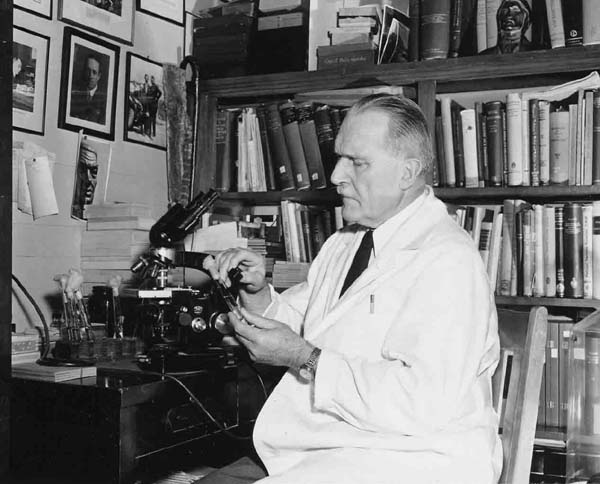
Karl F. Meyer in his office.

Karl F. Meyer in his office.

All but forgotten today, Meyer was once a nationwide figure renowned for his feats of disease detection. As director of the George Williams Hooper Foundation for Medical Research at UCSF in the 1920s, Meyer – a Swiss-born veterinarian and bacteriologist – spearheaded investigations into botulism, mussel poisoning, and brucellosis. By the 1930s he focused increasingly on parasitic diseases of birds and other animals.

These included ‘parrot fever,’ a deadly disease caused by a bacterium in parakeet droppings, and ‘staggers’ (equine encephalitis), a viral disease of horses spread by mosquitoes that bred in irrigation ditches. Most famously, they also included outbreaks of ‘sylvatic’ plague along the California-Oregon border – outbreaks that Meyer traced to migrations of squirrels and other flea-infested rodents. What linked these outbreaks is that, one way or another, they were all ‘man-made’ – the result of human interference with animal ecologies.

Drawing on Meyer’s papers at the UCSF and Bancroft libraries, this talk reviews Meyer’s feats of microbial detection and his pioneering investigations of disease ecology. Dr. Honigsbaum views Meyer as an important bridge figure in mid-20th century medical research who sought to link microbial behavior to broader environmental and social factors that impact host-pathogen interactions and the mechanisms of disease control.

mark_honigsbaum

Mark Honigsbaum

Mark Honigsbaum, PhD, is a medical historian and journalist with wide-ranging interests encompassing health, science, technology and contemporary culture. A specialist in the history of epidemics and pandemics, he is the author of four books, including The Fever Trail: In Search of the Cure for Malaria and A History of the Great Influenza Pandemics: Death, Panic, and Hysteria, 1830-1920. He is currently working on a history disease ecology as a Wellcome Research Fellow at Queen Mary University of London.

About the UCSF Archives & Special Collections Lecture Series

UCSF Archives & Special Collections launched this lecture series to introduce a wider community to treasures and collections from its holdings, to provide an opportunity for researchers to discuss how they use this material, and to celebrate clinicians, scientists, and health care professionals who donated their papers to the archives.

Commemorating UCSF Dental Alumni WWI Veterans

In honor of Veterans’ Day this year, we bring you a scrapbook from our collection, titled Dental College Alumni Serving in the First World War, 1917-1919. The scrapbook is filled with letters written to Dr. Guy S. Millberry by both former and on-leave students during their military service. Millberry began working at UCSF in 1906, was appointed Professor in 1910, and became Dean of Dentistry in 1914– a role he continued in for twenty-five years.

The collected letters were written from a variety of places– Camp Greenleaf, GA; Camp Fremont, CA; Vancouver, WA; Royat, France; Oakland, CA; Camp MacArthur, TX; San Pedro, CA; Camp Lewis, WA; Khabarovsk, Siberia; New York, NY; Fort D.A. Russell, WY; Camp Greene, NC; Camp Shelby, MS; Camp Lee, VA; La Ferte, France. They were sent from forts, camps, ships, submarines, and hospitals. Most of the the letters are handwritten, a few are typewritten.

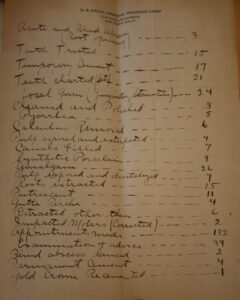
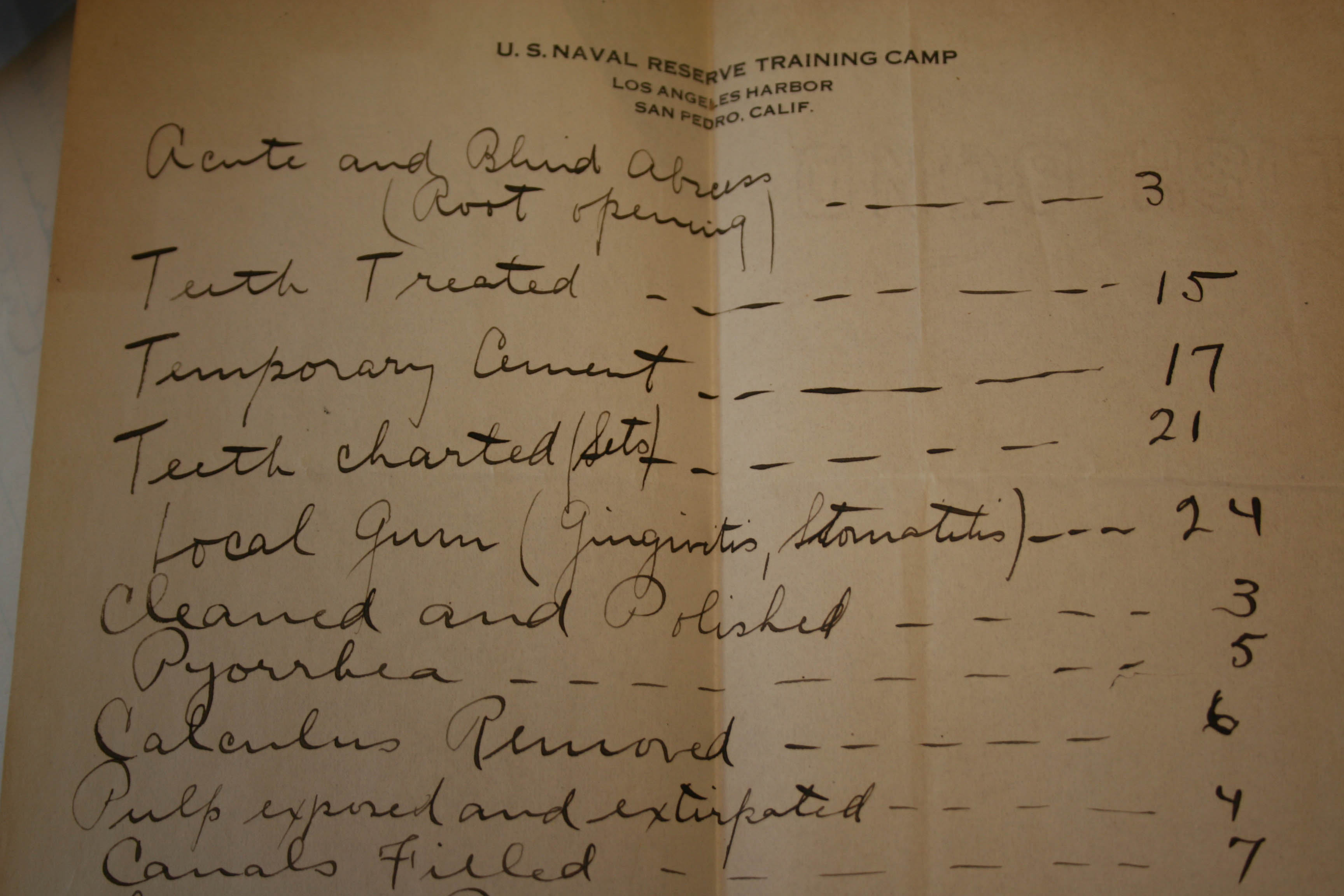
Dental College alumni Serving in the First World War, 1917-1919 scrapbook: details of dental work

Dental College Alumni Serving in the First World War, 1917-1919 scrapbook


The soldiers ask Dr. Millberry for letters of recommendation, job advice, proof of graduation, if their leave of absence will be honored or extended to allow them return to school after the war ends, and give updates on their lives. One soldier, who wrote on September 21, 1918, included a copy his records detailing the dental work he did in one week.

IMG_1790_small

Dental College Alumni Serving in the First World War, 1917-1919 scrapbook

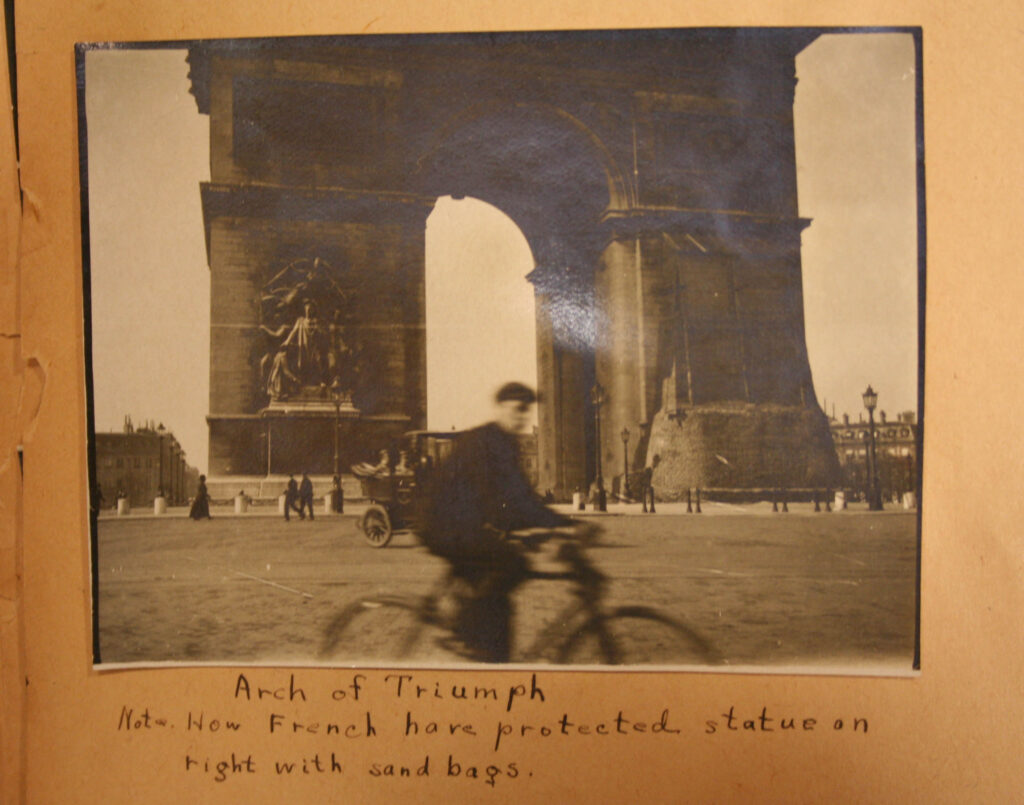
A graduate of the 1917 UC College of Dentistry class, Edwin Busse, wrote a letter on October 18, 1918 from his station in Paimboeuf, France that included several photographs (the letter is transcribed in full at the end of this post). Busse is pictured in the 1917 Blue and Gold UC yearbook as a member of the Psi Omega dentistry fraternity. Below, a photograph of the Arch de Triumph in Paris, France. The caption reads: “Note how French have protected statue on right with sandbags.”

Dental College alumni Serving in the First World War, 1917-1919 scrapbook: Arch de Triumph

Dental College Alumni Serving in the First World War, 1917-1919 scrapbook

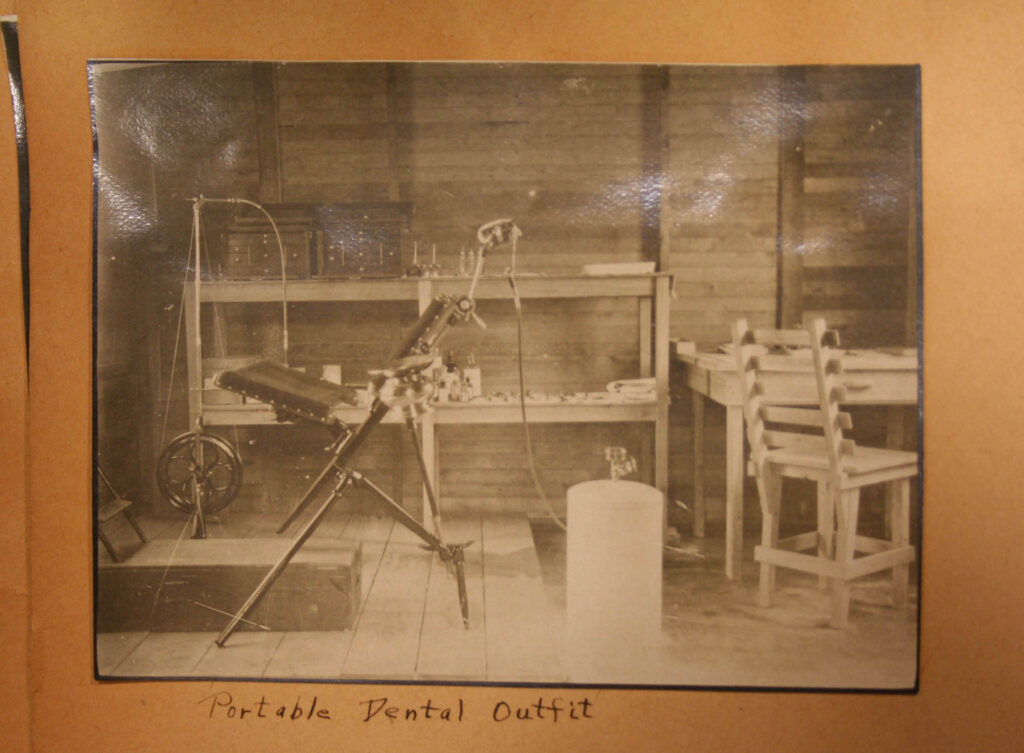
Included with same letter, a photograph of a “portable dental outfit.”

Dental College alumni Serving in the First World War, 1917-1919 scrapbook: Portable Dental Outfit

Dental College Alumni Serving in the First World War, 1917-1919 scrapbook

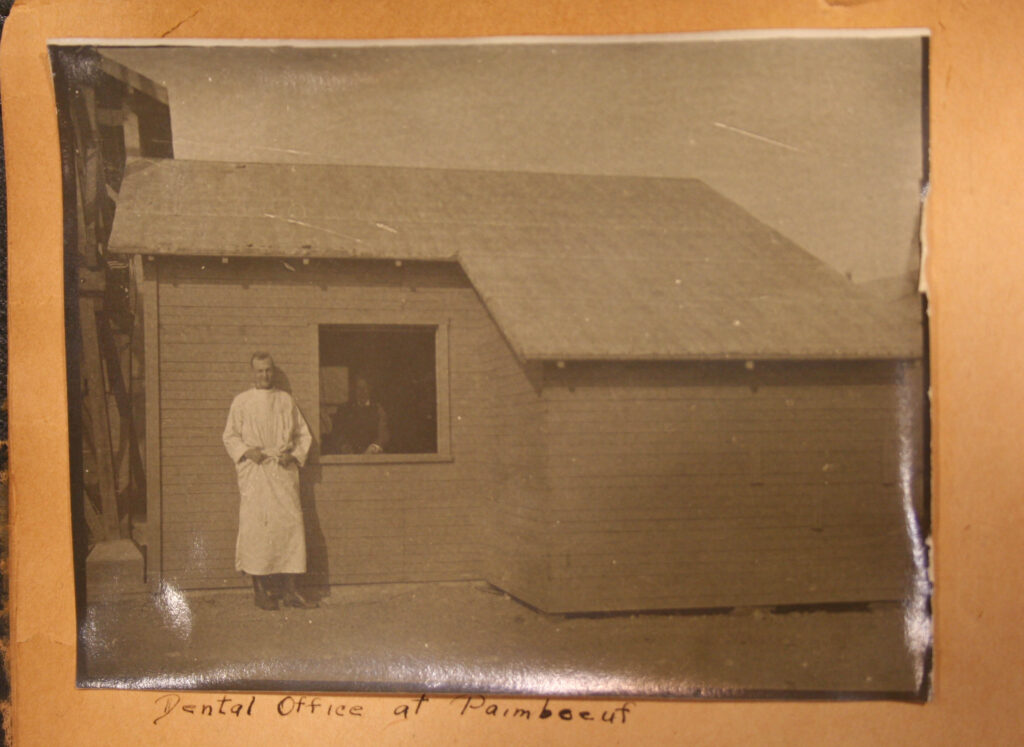
As well as a photograph of a “dental office at Paimboeuf.”

Dental College alumni Serving in the First World War, 1917-1919 scrapbook: Dental Office at Paimboeuf

Dental College Alumni Serving in the First World War, 1917-1919 scrapbook


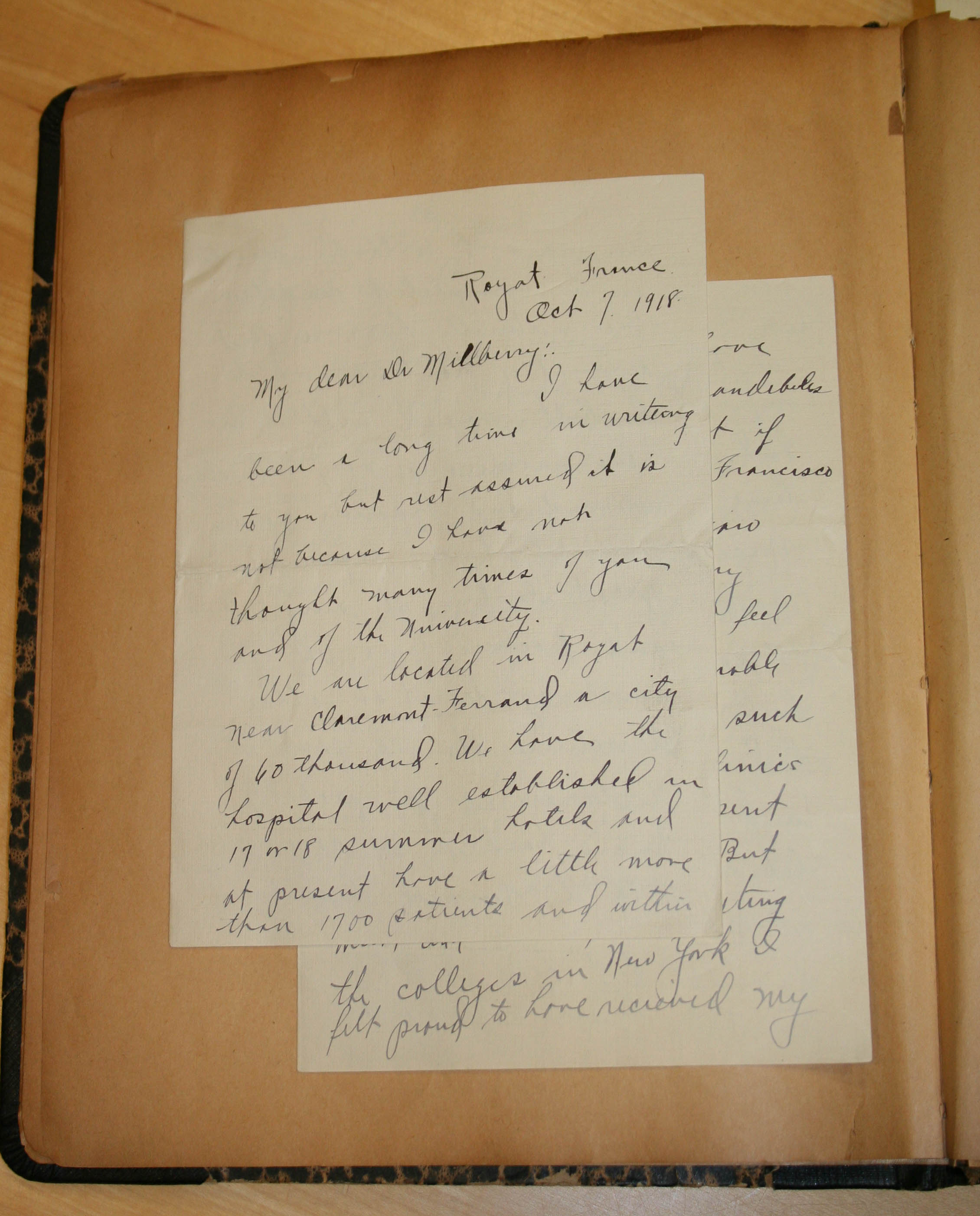
Clark R. Giles received his Degree of Doctor of Dental Surgery from UC in 1914 and had been an instructor in Prosthetic Dentistry here before serving in World War I. He wrote a detailed letter to Millbery on on October 7, 1918 from Royat, France describing the work that goes on at Base Hospital 30, the war, his recent leave, and even mentions Busse.


Dental College alumni Serving in the First World War, 1917-1919 scrapbook: detailed letter

Dental College Alumni Serving in the First World War, 1917-1919 scrapbook

Royat France
Oct 7, 1918

My dear Dr. Millberry:

I have been a long time in writing to you but rest assured it is not because I have not thought many times of you and of the University.

We are located in Royat near Claremont-Ferrand a city of 60 thousand. We have the hospital well established in 17 or 18 summer hotels and at present have a little more than 1700 patients and within a few months expect to be able to care for 3 thousand if necessary.

Our department is very comfortably (not lavishly, naturally) equipped and just at present we are five dentists and six assistants. However we expect to lose our extra help ere long but in all probabilities they will be replaced by men from incoming organizations. We are kept very busy for example last month we saw some 650 patients and we try to have each man who comes in, go out with his mouth in a completed condition. We naturally have a great amount of routine work to do but mixed with it are also numerous very interesting wound and fracture cases from which we learn a great deal in the surgical and fracture line. All cases involving facial or other structures than the jaws or teeth are as you probably know handled in conjunction with the surgical department.

Click through to read the rest of the letter written by Giles followed by the letter from Busse that included the photographs, written to Millberry a week later than Giles’, also from France.  Continue reading